Monday, 15 February 2021

ISLAMABAD, FEB 15 - Competition Commission of Pakistan (CCP) has recently passed an order against Strepsils Comfort for alleged deceptive marketing, which we are now going to appeal.
The discussions with CCP are ongoing since December 2018, during which we have presented numerous third-party researches to substantiate our actions, specifically claims made on effectiveness of Strepsils Comfort. However, CCP failed to consider our strong evidence and therefore we are now left with no other option but to appeal.
Honesty and transparency are fundamental operating principles for RB, and we ensure that our product positioning and communication is fair, honest and does not mislead consumers or is unclear in any manner.

All objective claims used in our communication and in our packaging & promotional materials are backed by credible and documented evidence capable of withstanding scientific scrutiny and comply with all local consumer laws.
We assure you that we are fully committed to protecting our consumers and will provide the best solutions that protect, heal and nurture for a healthier life.
About Reckitt Benckiser

Reckitt Benckiser is a growing community of 40,000+ diverse, talented entrepreneurs – united in the relentless pursuit of a cleaner, healthier world. Drawing on each other’s skills and working together, we put people at the heart of our business. Through research and development, science and partnership, we make products that people have loved and trusted for generations.
-------------------------------------------------------------------
COURTESY whenwherehow
-------------------

- The overall death toll is 2,395,099 people, while 60,902,994 coronavirus patients have already recovered.
KYIV, FEB 2021: The total number of confirmed coronavirus cases in the world exceeded 108.5 million patients as of February 14.
As many as 108,584,346 laboratory-confirmed COVID-19 cases had been reported as of 12:25 on February 14, according to the Coronavirus COVID-19 Global Cases dashboard by the Center for Systems Science and Engineering (CSSE) at Johns Hopkins University.
The overall death toll is 2,395,099 people, while 60,902,994 coronavirus patients have already recovered.
The highest death toll was recorded in the United States (484,250 people), Brazil (238,532), Mexico (173,771), India (155,642), the United Kingdom (117,128), Italy (93,356), France (80,955), and Russia (78,825).
The countries most affected by the coronavirus pandemic include the United States (27,575,636 confirmed cases), India (10,904,940), Brazil (9,809,754), the United Kingdom (4,038,929), Russia (4,026,506), France (3,467,051), Spain (3,056,035), Italy (2,710,819), and Turkey (2,579,896).
As many as 192 countries have been affected by the virus.
-----------------------------------------------------
COURTESY unian.info
---------------

KARACHI, FEB 15: Germany is the largest trading partner of Pakistan and the healthiest economy in the European Union have long ties with Pakistan. Pakistani people love the quality products and perceive that Made in Germany means quality and reliability.
The automotive sector of Germany is the symbol of status. This was stated by Mian Nasser Hyatt Maggo, President FPCCI in a meeting with the Ambassador of Federal Republic of Germany Excellency Bernhard Schlagheck who visited FPCCI Capital Office, Islamabad. The meeting was attended by a large number of business people from different sectors prominently Anjum Nisar, Immediate Past President FPCCI, Shahzeb Akram, Sr. Vice President and Vice Presidents of FPCCI, Zahid Shah, Hanif Lakhani, Athar Chawla, Head of Capital Office Qurban Ali and coordinator Mirza Abdul Rehman. Qaiser Khan Daudzai, Ex-Vice President of FPCCI.
Nasser Hyat Maggo gave a briefed overview of the activities of FPCCI and its importance not only in the Pakistan’s economy but also in the international economy. While talking about the bilateral trade of Pakistan with Germany, he said that Germany is the biggest trading partner of Pakistan in EU with a trade balance in favour of Pakistan which reflects good economic relation between both the countries. He further said that Current volume of bilateral trade is nearly US $ 3 billion. Pakistan’s Exports to Germany has increased to US $ 2 billion, while imports of Pakistan from Germany are US $ 1.2 billion. However, the trade statistics are still far beyond the existing potential between both the countries.
The President FPCCI further said that in the scenario of CPEC, Pakistan has become emerging market and favourable investment destination in the world. Many German companies are already operating in Pakistan but still there is a room for further investment in various sectors which should be jointly explored.
Anjum Nisar, Immediate Past President FPCCI said that Pak German development cooperation as well as bilateral trade and investment ties which are decades old and quite strong, it is high time to explore new avenues to enhance economic partnership through joint ventures in Special Economic Zones in Pakistan. He further said that the number of opportunities coupled with investment friendly policy of the government are there along with low cost labour and conducive domestic environment. The Agriculture yield of Pakistan is very poor and the land is shrinking annually and so we have to increase our yield for which German investors can come forward for joint collaboration in agriculture sector particularly in Seeds and pesticides, he added.
The Ambassador of Germany expressed his gratitude on his warm welcome in FPCCI and said that he was quite impressed with the viability of Pakistan business people who are subject related. The Chambers are doing well and moving forward for making business easy. He said that the bilateral trade was over US $ 3 billion earlier with surplus in favour of Pakistan, off-course there is more space to enhance economic partnership. We are interested to intensify business to business relations particularly in three areas i.e. recycling and waste management considering waste as resource not as garbage, sustainable construction together with micro facilities for renewable energies, Germany has quite enough experience of insulation of a building that keeps warm in winter and cool in summer time. This is very efficient from energy perspective and it will save a lot of money in longterm. Thirdly, the food processing and packaging area wherein Germany has good machinery and technology that can be helpful to Pakistan where the huge focus of the society is on agriculture, he added.
The Ambassador further said that last year a German business delegation visited Pakistan and had B2B meetings in Textile related Pakistani entrepreneurs. He said that they are planning another business delegation to Pakistan which will focus on these areas.
It was encouraging that both the countries were committed to further improve trade relations which is most promising and we hope that in future bilateral trade between both the countries would grow substantially, he added. Lastly the President FPCCI presented a traditional crest of FPCCI to the Ambassador as gesture of gratitude and appreciation.
--------------------------------------------------------
COURTESY dailyspokesman
----------------------

LAHORE, FEB 15: Pakistan won the third and final Twenty20 international against South Africa on Sunday with four wickets remaining, emerging victorious in the three-match series by 2-1.
Captain Babar Azam and opener Mohammad Rizwan picked up runs for Pakistan, scoring 44 and 42, respectively while Tabraiz Shamsi was the pick of the South African bowlers, taking four wickets.
Earlier, Pakistan won the toss and opted to bowl.
The win also makes Pakistan the first men’s team to reach a century of T20I wins.
S. Africa innings
Reeza Hendricks and Janneman Malan opened the innings for the visitors. South Africa suffered an early setback after Hendricks was bowled by Mohammad Nawaz in the second over.
The Proteas lost their second wicket soon after as Jon-Jon Smuts was caught out by Babar on Nawaz’s ball.
Just as it looked like South Africa was finding their footing after Pite van Biljon hit three boundaries off three balls, Hasan Ali got his revenge, bowling him out at the end of the over.
Zahid Mahmood, who made his international debut in today’s match, got his first wicket when Proteas captain Heinrich Klaasen was caught out by Usman Qadir off Mahmood’s ball.
He claimed his second wicket on the very next ball when Malan was ruled out lbw.
The quick loss of wickets continued with Andile Phehlukwayo getting caught out on duck off leg-spinner Usman Qadir’s ball.
Zahid claimed his third wicket in the 11th over, bowling out Dwaine Pretorius, the star of yesterday’s match.
The wickets continued falling with Hasan bowling out Bjorn Fortuin in the 16th over.
David Miller scored much-needed runs for the visitors after wickets fell in quick succession, hitting several boundaries to pick up 85 runs from 45 balls.
Pakistan innings
Rizwan and Haider Ali opened the innings for the home side. Rizwan, who top-scored for Pakistan in both the earlier T20Is, hit multiple boundaries in the opening overs.
Pakistan lost their first wicket in the seventh over as Haider was bowled out by Shamsi.
Rizwan’s wicket too fell to Shamsi who bowled him out in the ninth over. The hosts lost their third wicket to the left-arm spin bowler as well when we bowled out Hussain Talat.
Babar, who underperformed in the last two matches, returning to the pavilion in the early overs, hit several fours today to drive up Pakistan’s score.
But he was bowled in the 14th over by Pretorius.
In what turned out to be yet another remarkable performance, Shamsi collected his fourth wicket in the 15th over when Asif Ali was caught out by David Miller off his ball.
Faheem Ashraf was caught out by Miller off Bjorn Fortuin’s ball.
With the series locked at one-all, Pakistan had brought in leg-spinner Zahid Mahmood for his international debut.
Also included are batsman Asif Ali and medium pacer Hasan Ali. The trio replaced Khushdil Shah, Iftikhar Ahmed and Haris Rauf.
South Africa brought back Bjorn Fortuin for Glenton Stuurman.
Pakistan won the first match by three runs while South Africa took the second by six wickets, both in Lahore.
Teams
Pakistan: Babar Azam (capt), Haider Ali, Hussain Talat, Asif Ali, Mohammad Nawaz, Faheem Ashraf, Mohammad Rizwan, Shaheen Afridi, Hasan Ali, Usman Qadir, Zahid Mahmood.
South Africa: Heinrich Klaasen (capt), Reeza Hendricks, Janneman Malan, David Miller, Andile Phehlukwayo, Dwaine Pretorius, Tabraiz Shamsi, Lutho Sipamla, Pite van Biljon, Bjorn Fortuin, Jon-Jon Smuts.
----------------------------------------------------------
COURTESY DAWN NEWS
----------------
Sunday, 14 February 2021

- PU VC Prof Niaz Ahmed announced to give scholarships to Uzbek students and invited them to study in Punjab University.
LAHORE, FEB 2021 - On 11th February 2021, Punjab University Regional Integration Centre on Thursday marked Zaheer ud-din Babar Day by announcement of scholarships for Uzbek students, signing a MoU, organizing an art exhibition and a conference to promote bilateral relations with Uzbekistan.
The events were organized in collaboration with the Centre for Global and Strategic Studies and Uzbekistan’s Embassy at Al Raazi Hall.
Uzbek Ambassador Oybek Arif Usmanov called on PU Vice
Chancellor Prof Niaz Ahmed at his office to discuss enhancement of mutual
cooperation among the universities of both the countries.
A MoU was also signed between Punjab University and Uzbekistan’s Tashkent State University for exchange of teachers, students and launching of joint research projects.
On the occasion, PU VC Prof Niaz Ahmed announced to give
scholarships to Uzbek students and invited them to study in Punjab University.

In the conference titled “Legacy of Zaheer-Ud-Din Mohammad
Babur and Its Relevance in Contemporary Bilateral Relations between Pakistan
and Uzbekistan”, Uzbekistan’s Ambassador Mr Usmanov, Pro Vice Chancellor Prof
Dr Saleem Mazhar, Dean Faculty of Arts and Humanities Prof Dr Amra Raza, Centre
for Global and Strategic Studies (CGSS) member board of experts Dr Mahmood ul
Hasan, Executive Director Col (r) Khalid Taimur, Chairman PU Department of
History and Pakistan Studies Prof Dr Mahboob Hussain, PU Institute of
Communication Studies Director Prof Dr Noshina Saleem, PU College of Art and
Design Principal Prof Dr Sumera Jawad, PU Regional Integration Centre Director
Dr Fauzia Hadi Ali, University of Peshawar’s Area Study Centre Director Prof.
Dr. Shabir Ahmad Khan, PU’s Dr Faraz Anjum, Dr Rukhsana Iftikhar, other faculty
members and a large number of students participated in the conference.

Addressing the conference, Uzbek Ambassador Usmanov said that he was immensely impressed by the artwork of PU students in which they had truly reflected the culture of Uzbekistan in a creative manner.

He said that the life of Zaheer uddin Babar could be a guideline to promote bilateral relations between the two countries and there were many cultural similarities.
He said that Lahore was very dear to every Uzbek citizen. He said that Uzbekistan wanted to promote socio-economic relations with Pakistan. He said that the establishment of a rail track from Tashkent to Peshawar would play an important role in the promotion of trade and people to people contact.
He lauded PU VC Prof Niaz Ahmad for establishment of RIC and
promotion of the legacy of Zaheer uddin Babar in such a remarkable way.

In his statement, PU VC Prof Niaz Ahmad said that PU would extend full cooperation to promote mutual relations with Uzbekistan’s universities.
He said that PU would play its role for strengthening regional cooperation among friendly countries and RIC had been established keeping in view this purpose. Prof Vice Chancellor Prof Dr. Muhammad Saleem Mazhar in his remarks stated that PU would organize exchange programs for students and faculty.
He said that promotion of bilateral relations between the two countries was a need of the hour and PU would play a lead role in this regard. In his address, Prof Dr Mahboob Hussain said that Zaheer uddin Babar was the first king who wrote an autobiography.

He said that Zaheer uddin Babar invented Khat-e-Babri and he was also an excellent Sufi poet. He said that the life of Zaheer uddin Babar was a good source to promote strategic relations with Uzbekistan.
He stated that a framework would be devised for academic exchange between PU and Universities in Uzbekistan to find out the relevance in the shared history for the study of the contemporary world. Dr. Mehmood ul Hassan Khan stated that Babur was the most captivating personality in the oriental history. He said that Babur created one of the most powerful empires in the history of the East and was the first one to establish a connection with the soil of Pakistan.
Dr. Faraz Anjum highlighted the legacy which Babur bequeathed to his descendants and which served as an example for them to follow. He stated that Babur’s personality became an example for the latter rulers to follow. Dr. Rukhsana Iftikhar stated that Babur’s life was documented more than any other figure before colonial rule in the subcontinent.

Prof. Dr. Shabir Ahmad Khan stated that Babur was a man of extraordinary qualities. He was a leader, a soldier, an architect and an administrator.
He said that Zaheer ud Din Babur was a lover of nature and he was the best in generating loyalty and devotion amongst his followers. RIC Director Dr Fauzia Hadi Ali said that the centre would organize activities to enhance regional cooperation.

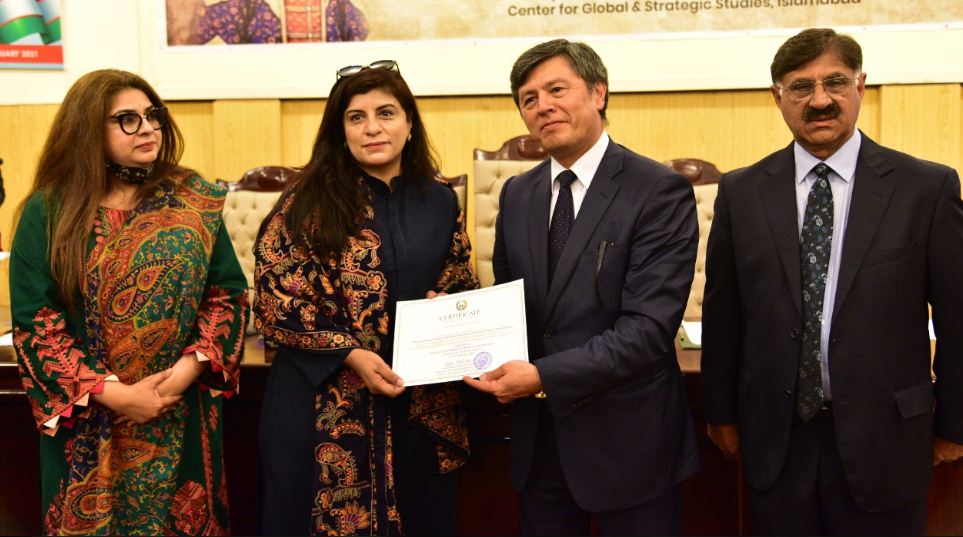

The conference highlighted the socio-cultural and historic legacy and common heritage of the two countries and avenues of cooperation and collaboration between Uzbekistan and Pakistan.
A Documentary was also screened at the occasion on “Uzbekistan-Pakistan: Shared Cultural & Islamic History” which was produced by the students of the PU Institute of Communication Studies under the leadership of Prof Dr Noshina Saleem and Dr Rashid Khan. Earlier, the Uzbek ambassador and others visited the art exhibition organized by PU College of Art and Design.
The ambassador lauded the creations of PU students and termed the artwork “impressive”. He also distributed shields and certificates among faculty members and students for their outstanding performance.
-------------------------------------------------------------
COURTEYS CGSS
------------

ANKARA, FEB 14: For the third time in history, the erstwhile state of Jammu and Kashmir will go without any political representation in Rajya Sabha — the upper house of the Indian parliament.
Four members of the parliament from the region, including leader of the opposition Ghulam Nabi Azad, are retiring by the end of this week, leaving their seats vacant.
The region disputed between India and Pakistan used to send six directly elected MPs to Lok Sabha — the lower house and four members elected by the state assembly to represent Rajya Sabha, also called the house of states.
On Aug. 5, 2019, when India revoked the autonomy and divided the state into two centrally-administered territories, Lok Sabha’s seats were redistributed, with five going to Jammu and Kashmir and one to the Ladakh region.
Since 2018, when the elected state assembly was dissolved, no mechanism was left to elect representatives for the Rajya Sabha. Then, Governor Satya Pal Malik dissolved the assembly, amid speculation that the regional parties National Conference and the People’s Democratic Party (PDP) were planning a coalition to form the government.
Earlier, also the upper house was left without any representation from the disputed region from April 1994 to October 1996, as there was no elected assembly from 1991 to1996.
The seats remained vacant also for three months from November 2008 to February 2009, when the state was under the governor’s rule.
In 1991-1996, the state lacked representation in Lok Sabha as well, because due to the volatile security situation parliamentary elections could not be conducted in 1991.
40 MPs represented region in Rajya Sabha
Since 1952, when the first batch of four members was elected by the state’s Constituent Assembly to occupy seats in Rajya Sabha, 40 people have represented Jammu and Kashmir.
Azad, who was also the chief minister of the region in 2005-2008, has been a member of the house five times — four times from Jammu and Kashmir, and once from the western state of Maharashtra.
Tirath Ram Amla, a politician from the Jammu division, was a member of the house four times from 1967 to 1985, followed by Saifudin Soz, who has represented the region thrice.
Speaking to Anadolu Agency over the phone, outgoing MP Nazir Ahmed Laway said he was hoping for the restoration of statehood and an elected assembly in the region soon. He said six years ago he had become an MP when the state comprised Jammu and Kashmir and Ladakh.
Azad also said that in the absence of assembly and local representatives, he is receiving lots of delegations who come from Kashmir to Delhi seeking his intervention in one or the other.
“The state is without an assembly for the past two-and-a-half years. If there was any local elected representative, the people would go to him for grievances. They come all the way to Delhi spending their resources,” he said.
Currently, a delimitation commission headed by former Supreme Court judge Ranjana Desai is working to demarcate boundaries of the constituencies afresh to increase seats in the state assembly.
“We are expecting to complete the exercise in the next two months. After this exercise, the central government may decide to conduct assembly elections,” said a member of the commission, who requested anonymity.
According to the Jammu and Kashmir Reorganization Act adopted by the Indian parliament in August 2019, the number of seats in the assembly will rise from 107 to 114. The 24 seats reserved in the Jammu and Kashmir Assembly for the areas under Pakistan’s administration will remain untouched. Also, in the next assembly, few seats will be reserved for the lower caste Hindus and tribal areas.
Though India had adopted the procedure for adult suffrage in the matter of Lok Sabha or lower house election in 1952, this procedure was implemented in Jammu and Kashmir in 1967. Before that, MPs were nominated to represent the state in the lower house.
Frequent central rule
The state has also remained under the direct central rule for over 10 years in the past 30 years. In 1990, when armed resistance broke in the region, Chief Minister Farooq Abdullah’s National Conference-led government resigned. It continued until October 1996, when the assembly elections were held under an unprecedented security cordon.
After the 2002 assembly elections, the governor’s rule was once again imposed for a period of 15 days due to a deadlock over the formation of a government. Again, in July 2008, the state came under the governor’s rule after the PDP withdrew its support from Ghulam Nabi Azad’s Congress-led government. This period of the governor’s rule lasted for 178 days.
After the 2014 assembly polls threw up a fractured mandate, the state again remained under the central rule for 52 days before the BJP and PDP formed the government in March 2015.
The central rule was again imposed in January 2016 for 87 days after the then-Chief Minister Mufti Muhammad Sayeed passed away until his daughter Mehbooba Mufti was elected to lead the alliance.
This government collapsed on June 19, 2018, after the BJP withdrew its support. Until then, the state was under the central rule.
Upper house or Rajya Sabha
The upper house of the Indian parliament is a permanent house having a maximum of 245 members, of which 233 are elected by the state assemblies using single transferable votes through an open ballot. The Indian president can appoint 12 members for their contributions to art, literature, science, and social services.
The upper house has limited powers in passing money bills like the annual budget. If Rajya Sabha fails to return the money bill to Lok Sabha within 14 days, that bill is deemed to have been passed by both the parliaments.
But in terms of making laws for the states, this house has powers to pass a resolution by a two-thirds supermajority granting such power to the parliament.
Otherwise, under the Indian constitution, the central government cannot make a law on a matter reserved for states without any authorization from Rajya Sabha. Prime Minister Narendra Modi-led government used this clause to divide the state of Jammu and Kashmir.
Elections to Rajya Sabha
The elected members of the state assemblies are allowed to vote in a Rajya Sabha election. The legislators send a batch of new members to the upper house every two years for a six-year term.
A third of members of this permanent house from each state retire once in two years and polls are held to fill up the vacancies. In addition, vacancies that arise due to resignation, death, or disqualification are filled up through by-polls after which those elected serve out the remainder of their predecessors’ term.
The election is held on the principle of proportional representation by a single transferable vote, which means a bloc of members belonging to one or more parties can elect an MP of their choice if they have the requisite numbers. This is to avoid the principle of majority, which would mean that only candidates put up by the ruling parties in the respective states will be elected.
A single transferable vote means that electors can vote for any number of candidates in order of their preference. Care has been taken that the ruling party with two-third of the majority does not take all seats.
As a measure to check rampant cross-voting, the assembly member shows his or her marked ballots to the party’s authorized agent before putting them into the ballot box.
---------------------------------------------
COURTESY aa.com.tr/en
-------------------

LAHORE, FEB 14– South Africa won the second Twenty20 International against Pakistan by six wickets at the Gaddafi Stadium in Lahore on Saturday.
Pite van Biljon and Reeza Hendricks both scored 42 as South Africa chased down a modest 145-run target in just 16.2 overs. The third and final match is on Sunday, also in Lahore.
David Miller and captain Heinrich Klaasen saw the visitors through with more than three overs left.
Shaheen Shah Afridi struck twice for Pakistan early on to get rid of Janneman Malan and JJ Smuts in the first and third over, respectively.
Afridi struck with the second ball of the innings to clean up Malan, giving Pakistan the ideal start. However, the Proteas made a recovery, scoring a flurry of boundaries against pacer Haris Rauf.
Pakistan had scored 144 runs for the loss of seven wickets in 20 overs. Mohammad Rizwan scored a half-century, hitting 51 runs from 41 balls.
According to the Pakistan Cricket Board (PCB), Rizwan is the first Pakistani wicketkeeper-batsman to score 50+ runs in three consecutive T20I matches.
Faheem Ashraf made 30 not out of 12 balls to help Pakistan reach a respectable total after the middle order failed to contribute.
Pakistan lost captain Babar Azam early on in the second over after he was adjudged lbw, managing only five runs.
Youngster Haider Ali was the second to go back into the pavilion after a brilliant catch on the square leg boundary by Lutho Sipamla in the fifth over. Ali scored 10 runs from 11 balls.
The third wicket to fall was Hussain Talat, who was out to Tabrez Shamsi for three runs in the seventh over. Iftikhar Ahmed was the fourth wicket, scoring 20 runs from 21 balls. He was sent back to the pavilion in the 14th over.
Earlier, South Africa had won the toss and opted to field first.
Pakistan had won the first T20I after Mohammad Rizwan’s 104-run knock propelled the green shirts to victory.
It was Rizwan’s highest-ever score in a T20I match and helped Pakistan set a respectable target for the visitors after the hosts suffered a loss early on when captain Babar Azam was run out in the very first over.
South Africa have made three changes to the squad with Glenton Stuurman, JJ Smuts and Pite van Biljon coming in for Jacques Snyman, Bjorn Fortuin and Junior Dala.
Stuurman will be making his T20I debut for South Africa.
Playing 11
Pakistan: Babar Azam (capt), Mohammad Rizwan (wk), Haider Ali, Hussain Talat, Iftikhar Ahmed, Khushdil Shah, Mohammad Nawaz, Faheem Ashraf, Usman Qadir, Shaheen Shah Afridi, Haris Rauf
South Africa: Janneman Malan, Reeza Hendricks, JJ Smuts, Pite van Biljon, David Miller, Heinrich Klaasen (capt, wk), Andile Phehlukwayo, Dwaine Pretorius, Glenton Stuurman, Lutho Sipamla, Tabraiz Shamsi
--------------------------------------------------------
COURTESY DAWN NEWS
-------------
Saturday, 13 February 2021

Munaza Kazmi
Pakistan is a beautiful country, filled with awesome people and the best mountain ranges on the planet… The Himalayas are truly without rival anywhere in the world. I’ve spent months traveling Pakistan over the last year and I cannot recommend this incredible country enough…
Nevertheless, Pakistan is one of the most misjudged
travel destinations for a variety of reasons. Hence, there is a fair bit of taboo surrounding travel
in Pakistan – thanks, media – but really, Pakistan is a very safe
country to visit.
ISLAMABAD

Islamabad is the capital city of Pakistan but not even close to the biggest city. There are 213 million people in Pakistan and just 1 million in Islamabad. That makes the city great for a stopover and introduction to the country. I’d recommend at least one day to explore Islamabad.

Start the day right
with one of the best coffees in Islamabad, found at Mocca Cafe in
Kohsar Market. While you are there be sure to wander around and begin to
experience the local shopping. I would suggest taking advantage of the
opportunity to buy some handicrafts, that would remind you of this mesmerizing
land, when home. For a beautiful pashmina, head over to F6 markez,
school road. For Afghan Handicrafts and antiques head over to
the few shops around the corner from Maharaja Handicrafts on Aga Khan Road near
the flower market.

I would suggest, if
you are a nature lover, then you must visit the hiking trails, since it is
awonderful passage with a lot of beautiful surprises awaiting, like mesmerizing
fresh water pools and waterfalls, a glace of little squirrels playing around, a
hello from a mama monkey, or a lovely song from a colorful rare sparrow and
maybe a meeting with a leopard…. leopards do live in the forest, so it’s better
to visit in the day light and with guide.

This trail will lead you to a superb restaurant on the hill top, Monal, where you can fill your appetite, by having breakfast buffet and view of whole city.

In the mean while when
you would be landing back to the city from Monal, I would recommend you stop by
Faisal Mosque, to glace at the
serenity and the art of perfection.

Running with the clock, the day can be spent in the lush green Shakrparia, where you can have an
opportunity to witness the gigantic Pakistan
National Monument and Heritage Museum, a blooming flower petal-shaped structure built of granite,
with the inner walls inscribed with the outlines of Pakistan’s landmarks i.e.
Lahore Fort, Badshahi Mosque, Khyber Pass and Minar-e-Pakistan.

Nearby,
in the Garden Avenue, it’s located a heritage museum Lok Virsa, which I would recommend you pay a visit, since it is
itself a history, showcasing the true colors of Pakistan. Also, don’t forget to
have lunch in the 1969 Restaurant,
located on the opposite of the museum, that is based on 1960’s Pakistan Film Industry theme, where one could see the
flashback of time.

For
the evening, get ready to have an experience of a blend of culture with a cup
of tea. Saidpur Village, more than 500
years, located at slopes of Margalla Hills, and known for its heritage,
culture, history and, folklore. The area is now look after by local government
and have been transformed into restaurants for tourist. By sitting in one of the resultants there,
one could image how glamorous the past was, the blend of three epochs; Muslim,
Hindu and Sikhs.

Later check in to the Serena Hotel if you want an unforgettable introduction to Pakistani culture, architecture, and opulent interiors inside what is considered the most beautiful hotel in Islamabad. The hotel has all the perks you could ever need, including an outdoor swimming pool, fitness center and huge restaurant to enjoy a buffet dinner.
--------------------------------------------------------
COURTESY dailyspokesman / pic taken from twitter
-------------------------------

LAHORE, FEB 13: After recording a thrilling three-run victory against South Africa in the first Twenty20 International at the Gaddafi Stadium on Thursday, Pakistan seek to claim the series in the second game at the same venue on Saturday.
Though Pakistan were termed favourites to clinch the series opener under lights, a largely inexperienced but pumped up South African line-up fully stretched the hosts who in the end only managed to sneak home by three runs while defending a total of 169 as paceman Faheem Ashraf conceded 15 runs off a costly final over.
Batting display by all Pakistan players, except for gritty Mohammad Rizwan, remained below par in the first T20. Captain Babar Azam (0), Haider Ali (21), Hussain Talat (15), Khushdil Shah (12), Iftikhar Ahmed (4) and Faheem (4) all failed with the bat. And had Rizwan, who opened with Babar after Heinrich Klaasen opted to bowl first, not scored a gallant century (104 not out off 64 balls), the end result could have been opposite.
Though the home team’s spin duo of Usman Qadir (2-21 off four overs) and Mohammad Nawaz (0-21 off four overs) impressed on Thursday, all their pace bowlers were found wanting which almost cost them the match. Babar and company will need to look into this and make sure that fast bowlers make worthy contributions and support their spinners.
For South Africa, the situation does not seem encouraging as far as their batting is concerned. Apart from openers Janneman Malan (44) and Reeza Hendricks (54) who gave their team a brisk 53-run start inside the first six overs, all the other players including Klaasen fared poorly with the willow, particularly finding spin difficult to handle.
Klaasen’s approach of employing as many as seven bowlers also proved futile.
While the hosts are likely to retain the winning combination, South Africa may make a couple of changes to cover their bases for today’s game which is do-or-die for them.
Fog and dew factor has emerged during the last couple of days, posing a significant threat to completing the match. Heavy fog was witnessed during Thursday’s T20 and the situation was almost the same on Friday morning as well as evening.
However, encouraging is the fact that the met office has not forecast any rain till Sunday.
Teams (from):
PAKISTAN: Babar Azam (captain), Aamer Yamin, Amad Butt, Asif Ali, Danish Aziz, Faheem Ashraf, Haider Ali, Haris Rauf, Hussain Talat, Iftikhar Ahmed, Khushdil Shah, Mohammad Hasnain, Mohammad Nawaz, Mohammad Rizwan (wicket-keeper), Sarfaraz Ahmad (wicket-keeper), Shaheen Shah Afridi, Usman Qadir, Zafar Gohar, Zahid Mahmood
SOUTH AFRICA: Heinrich Klaasen (captain/wicket-keeper), Nandre Burger, Okuhle Cele, Junior Dala, Bjorn Fortuin, Reeza Hendricks, George Line, Janneman Malan, David Miller, Andile Phehlukwayo, Dwaine Pretorius, Ryan Rickelton (wicket-keeper), Tabraiz Shamsi, Lutho Sipamla, J.J. Smuts, Glenton Stuuman, Pite van Biljo (wicket-keeper)
Umpires: Shozab Raza and Asif Yaqoob (both Pakistan)
TV umpire: Ahsan Raza (Pakistan)
Match referee: Mohammad Javed Malik (Pakistan).
-----------------------------------------------------
COURTESY DAWN NEWS
------------
Social Media
Search