Friday, 2 April 2021

TAIPEI, APR 2: Dozens of people are feared dead after a packed train derailed inside a tunnel in eastern Taiwan on Friday at the start of a long holiday weekend, with rescuers still scrambling to reach others trapped inside.
Police said at least 36 people were classified as showing no signs of life when rescuers reached them in what looks set to be the island's worst rail disaster in decades.
A further 70 people were still thought to be trapped in carriages inside the tunnel while around 60 were rushed to hospital.
Officials said the accident could have been caused by a maintenance vehicle sliding down an embankment and striking the train before it entered the tunnel near the coastal city of Hualien.
“There was a construction vehicle that didn't park properly and slid onto the rail track,” Hualien county police chief Tsai Ding-hsien told reporters.
“This is our initial understanding and we are clarifying the cause of the incident,” he added.
Local media pictures from the scene showed the back of a yellow flatbed truck on its side next to the train.
President Tsai Ing-wen's office said she had ordered hospitals to prepare for a mass casualty event. “The top priority now is to rescue the stranded people,” it said in a statement.
The accident occurred on Taiwan's eastern railway line around 9:30am (0130 GMT).
Pictures published by local news website UDN showed the front of the train inside the tunnel had been pulverised into a twisted mesh of metal.
The Central Emergency Operation Center gave a lower suspected death toll of 26 people showing no signs of life.
Escape by roof
People further back in the train were able to walk away from the crash comparatively unscathed.
A live broadcast by UDN outside the tunnel showed a row of undamaged train carriages with rescuers helping passengers escape.
“It felt like there was a sudden violent jolt and I found myself falling to the floor,” an unidentified female survivor told the network, saying she suffered a cut to her head.
“We broke the window to climb to the roof of the train to get out,” she added.
The eight-car train was travelling from Taipei to the southeastern city of Taitung and was carrying about 350 passengers.
The accident occurred at the start of the busy annual Tomb Sweeping Festival, a long holiday weekend when Taiwan's roads and railways are usually packed.
During the festival, people return to ancestral villages to tidy up the graves of their relatives and make offerings.
Taiwan's eastern railway line is usually a popular tourist draw down its dramatic and less populated eastern coastline.
With the help of multiple tunnels and bridges, it winds its way through towering mountains and dramatic gorges before entering the picturesque Huadong Valley.
Friday's crash looks set to be one of Taiwan's worst railway accidents in recent decades.
The last major train derailment in Taiwan was in 2018 and left 18 people dead at the southern end of the same line.
The driver of the eight-carriage train was later charged with negligent homicide. More than 200 of the 366 people on board were also injured.
That crash was the island's worst since 1991, when 30 passengers were killed and 112 injured after two trains collided in Miaoli.
Thirty were also killed in 1981 after a truck collided with a passenger train at a level crossing and sent coaches over a bridge in Hsinchu.
And in 2003, 17 died and 156 were injured after a train on the Alishan mountain railway plunged into a chasm at the side of the track.
--------------------------------------------------------
COURTESY DAWN NEWS
----------------

ISLAMABAD, APR 2: Russian Foreign Minister Sergey Lavrov will arrive here next week to hold talks with his Pakistani counterpart Shah Mahmood Qureshi on the Afghan peace process, sources told Dawn.
This will be the first visit of a Russian foreign minister to Pakistan since 2012.
Before arriving in Islamabad on April 6, Mr Lavrov is scheduled to visit New Delhi. He will be accompanied by Russia’s special envoy on Afghanistan Zamir Kaboluv.
With the Afghan situation on top of the agenda, the two foreign ministers will also discuss bilateral ties, including economic cooperation and counterterrorism and socio-economic ramifications of the Covid-19 pandemic.
Leaving the bitterness of the past behind, Islamabad and Moscow have developed strategic trust and share views on various issues, including the Afghan problem.
Russia recently hosted a conference of Pakistan, the United States, China and representatives from the Afghan government and the Taliban as part of its efforts to break the stalemate in the ongoing Afghan peace process.
Russia, like Pakistan, China and Iran, is concerned that the US withdrawal from Afghanistan without a prior peace deal could jeopardise regional security.
--------------------------------------------------
COURTESY DAWN NEWS
-------------
Thursday, 1 April 2021

BAKU, APR 1: A draft agreement between the governments of Kyrgyzstan and Azerbaijan on air traffic was approved at the meeting of the Committee of the Jogorku Kenesh (unicameral parliament of Kyrgyzstan, the legislative state body) on transport, communications, architecture and construction on March 30, Trend reports with reference to the Kyrgyz media.
It is planned to launch flights between the countries within this agreement.
Minister of Transport, Architecture, Construction and Communications of Kyrgyzstan Gulmira Abdralieva said that two carrier airlines - Air Manas - from Kyrgyzstan and Azerbaijan Airlines (AZAL) - from Azerbaijan were chosen upon the agreement of the sides.
Abdralieva stressed that the sale of tickets in the direction of both countries is planned to be launched in May 2021.
Kyrgyzstan will receive two new Airbus 220 aircraft in April.
-----------------------------------------------------
COURTESY en.trend.az
------------------

ISLAMABAD, APR 1: The federal cabinet on Thursday deferred the Economic Coordination Committee's (ECC) decision to allow the import of sugar, cotton and cotton yarn from India through land and sea routes.
The decision has been deferred until India reinstates Article 370 of its Constitution, which guaranteed a semi-autonomous status for Indian-occupied Kashmir. Pakistan had suspended all bilateral trade with Indian following New Delhi's decision to revoke Article 370 in August 2019.
"Today Cabinet stated clearly NO trade with India," Minister for Human Rights Shireen Mazari tweeted.

She said Prime Minister Imran Khan had made it clear that "there can be no normalisation of relations with India until they reverse their illegal actions" regarding occupied Kashmir taken on Aug 5, 2019.
Speaking to Geo News, Foreign Minister Shah Mehmood Qureshi also said the cabinet had ruled that "normalising relations with India will not be possible" until it overturned the measures it took regarding occupied Kashmir's special status.
"A perception was emerging that relations with India have moved towards normalisation and trade has been opened," Qureshi said. "There was an exchange of thoughts on this and there was a unanimous opinion on this and it was the prime minister's [opinion] as well that as long as India does not review the unilateral steps it took on August 5, 2019, normalising relations with India will not be possible."
Earlier today, Mazari had stated that all ECC decisions "have to be approved by the federal cabinet".
"Only then they can be seen as 'approved by government'," she said, adding that the "media should be aware of this at least".

Finance Minister Hammad Azhar had made the decision to restore trade ties with India public on Wednesday, stating that the price of sugar in India is "significantly cheaper than Pakistan; therefore, we have decided to open its trade and allow commercial import of 500,000 tonnes of white sugar”.
The minister had said the decision was taken to improve supplies and discourage price hike in Pakistan as sugar in India was 15pc to 20pc cheaper.
An official statement had said the ECC allowed the commercial import of white sugar from India till June 30, 2021, through land and sea routes, on the basis of the quota issued by the Ministry of Commerce. The decision would be time and cost effective and would also stabilise the prices of sugar in the domestic markets, it had added.
Prime Minister Imran, who is also Minister-in-Charge of Commerce and Textile, had approved the summaries for import of cotton, cotton yarn and sugar to be placed before the ECC for approval. It meant that the prime minister was already in support of lifting the ban on these products' imports from India.
------------------------------------------------
COURTESY DAWN NEWS
------------

- Huawei reaffirms commitment to creating greater value for customers and society in the face of adversity
ISLAMABAD, APR 1: Huawei released its 2020 Annual Report.
Growth slowed, but the company's business performance was largely in line with
forecast. Huawei's sales revenue in 2020 rounded off at approximately US$136.7
billion, up 3.8% year-on-year, and its net profit reached US$9.9 billion, up
3.2% year-on-year.
Despite operational difficulties brought about by US
sanctions in 2019 and 2020, Huawei has and will continue to invite KPMG to
independently and objectively audit our financial statements. The document
produced by KPMG is a standard unqualified audit opinion. No matter the
circumstances, we will continue to embrace transparency by disclosing
operational data to governments, customers, suppliers, employees, and partners.
In 2020, Huawei's carrier business continued to ensure the
stable operations of more than 1,500 networks across more than 170 countries
and regions, which helped support tele work, online learning, and online
shopping throughout COVID-19 lock downs. Working together with carriers around
the world, the company helped provide a superior connected experience and moved
forward with more than 3,000 5G innovation projects in over 20 industries like
coal mining, steel production, ports, and manufacturing.
Over the past year, Huawei's enterprise business stepped up efforts to develop innovative scenario-based solutions for different industries and create a digital ecosystem that thrives on joint creation and shared success. During the pandemic, Huawei provided technical expertise and solutions that were vital in the fight against the virus. One example is an AI-assisted diagnostic solution based on HUAWEI CLOUD that helped hospitals the world over reduce the burden on their medical infrastructure. Huawei also worked with partners to launch cloud-based online learning platforms for more than 50 million primary and secondary school students.
With the roll out of Harmony OS and the Huawei Mobile
Services (HMS) ecosystem, Huawei's consumer business moved forward with its
Seamless AI Life strategy ("1 + 8 + N") to provide consumers with an
intelligent experience across all devices and scenarios, focusing on smart
office, fitness & health, smart home, easy travel, and entertainment.
"Over the past year we've held strong in the face of
adversity," said Ken Hu, Huawei's Rotating Chairman. "We've kept
innovating to create value for our customers, to help fight the pandemic, and
to support both economic recovery and social progress around the world. We also
took this opportunity to further enhance our operations, leading to a
performance that was largely in line with forecast.
"We will continue to work closely with our customers
and partners to support social progress, economic growth, and sustainable
development."
All financial statements in the 2020 Annual Report were independently audited by KPMG, an international Big Four accounting firm. To download the 2020 Annual Report, visithttps://www.huawei.com/en/annual-report/2020.
-----------------------------------------------------------------

ISLAMABAD, APR 1: An Online International Conference on “Evolving Global Security Challenges in the Post-COVID World” was organized by the Center for Global & Strategic Studies (CGSS), Islamabad.
The conference commenced with the opening remarks of Dr. Mehmood Ul Hassan Khan, Member Board of Experts, Center for Global & Strategic Studies (CGSS), Islamabad& Regional Geopolitical Analyst.
He stated that the COVID-19 pandemic has further
disorganized existing global challenges, further exposing the underlying causes
of insecurity, social and economic inequality with overtones of racial tension
and nationalism. Furthermore, it is the knowledge that must be provided to
decision-makers in-charge of internal and civil security to shift from
forecasts to informed actions.
Mr. TolgaSakman, Chairman, Center for Diplomatic Affairs and
Political Studies (DIPAM), Istanbul, Turkey discussed re-evaluating the
international security architecture in the Post-Covid-19 era, potential areas,
and policy options for Eurasia.
He further highlighted that the post-covid era has altered the security architecture. In recent years central Asia, East Asia, and the Baltic sea have become crucial as Russia and China work on post-liberal political and economic arenas.
Post covid security architecture has resulted in new
consequences as the global supply chains have high effects on how democratic
establishments can rescale peoples’ employment. He mentioned the idea of Global
Partnership Cooperation to be the most essential ingredient for this new
change.
Prof. Dr. Iram Khalid, Chairperson, Department of Political
Science & IR, University of the Punjab, Lahore, Pakistan emphasized the
impact of COVID-19 on the security dynamics of Asia
According to Dr. Iram, there are three major components to security dynamics that first and foremost include compartment reservation of Asia. It has become challenging to practice nontraditional security power. She emphasized the contemporary concepts where national security depends greatly upon the tangible and non-tangible interests and elements.
Furthermore, keeping in view the concept of commonality on
an international scale, paradigms of new discussions have opened for foreign
policymakers. She also mentioned that interconnectivity has altered the designs
of traditional security into non-traditional security. Therefore, orthodox
paradigms need revision to facilitate the worldwide new connections.
Dr. Adam Saud, Dean, Faculty of Humanities & Social
Sciences, Bahria University, Islamabad, Pakistan discussed the shifting of
focus from the War on terror towards the strategic competition between the US,
China, and Russia.
He further commented that the post-cold war political
scenario changed as the US wanted to establish its global might. War on
terrorism dominated global politics previously but post 2008, as the US
underwent an economic crisis China began to revitalize the geo-economics realm.
He emphasized that on the creation of geopolitical capital there is a gap to
know who is the great power coefficient of the future? According to Dr. Adam
Saud, the economic crisis and problems arising from lack of consensus can be
tackled if the US recognizes China's strategic competitiveness. Furthermore, in
the contemporary era, the position holders will be visible as per their
positive role.
Dr. Shafiah F Muhibat, Director of International Relations,
Center for Strategic and International Studies (CSIS), Jakarta, Indonesia
discussed the Security Challenges and Alignments in East Asia.
She further elaborated some major areas to illustrate the
regional security challenges; maritime security, great power politics,
humanitarian challenges, and challenges posed by Covid-19. She believed that
further assistance and cooperation of regional states can enhance Maritime
security. Dr. Shafiah further added to the discussion by signifying the
cooperative role of hyper-potential countries like Korea in peacefully settling
clashes. She also emphasized that despite the great power politics and tensions
South Asia carries huge potential to smoothen the scenario by setting regional
order as the top priority. This can be done by establishing trust and covering
relations by efficiently responding to the challenges.
Dr. Aiysha Safdar, Head of International Relations
Department, Kinnaird College For Women University, Lahore, Pakistan shared her
views on redefining national security in the context of Pakistan
She also discussed that the arrival of Covid-19 has exposed
the vulnerabilities on several fronts. Human security is a huge part of the
national security caused by poverty, terrorism, economic downturns, etc. As the
insecurities overlap they expand and take roots in several domains of societal
strata. Highlighting the issues faced by the educational institutions she
mentioned that the education sector has suffered due to lacking sustainable
developmental goals as traditional learning shifted to online learning. Hence,
the heavy long-term changes and challenges to mankind require a reinvention of
new paradigms of national security and geo-strategies and heavy investments in
human health.
Mr. Shakeel Ahmed Ramay, Director, China Study Center,
Sustainable Development Policy Institute (SDPI), Islamabad, Pakistan highlighted
how the Covid-19 pandemic is reshaping the China-US competition
He also discussed that given the global pandemic future
changes are introducing new competitions in two major areas i.e. in the economy
and the mobility capacity. In the present-day globalization process,
technological emergence leads to competition in the better mechanized
technological supply chains. Thus, having technology as the key area there is
serious increasing competitiveness between China and the US. Therefore, the
advantage can only be gained by countering the negative impacts of this growth
and securing positive productive outcomes.
Dr. Naheed S. Goraya, Assistant Professor, Centre for South
Asian Studies, University of the Punjab, Lahore, Pakistan discussed the
collaborative approach worldwide to counter Non-Traditional Security Threats.
She further discussed that keeping in view rising
Islamophobia it is important to give rise to cohesion and economic cooperation.
We have to understand that the lack of knowledge is hindering integration and
resulting in a rise to the vulnerability of isolation. If the issue is not
addressed in time it will generate identity-based extremism because of
politicizing of religion. We have to understand the main drivers of
Islamophobias and its relation with radicalism. To counter this symbiotic
relation, Muslim leaders must actively promote Islamic theologies, to create
trust and understanding. This would create harmony on inter-cultural grounds.
Prof. Sun Lu, Associate Professor, School of Government
& Public Affairs, Communication
University of China, Beijing, China discussed China’s approach in the context
of rising Multi-polarity and the Emerging geopolitical environment
She also highlighted that from the historic content of
almost a hundred years ago, it can be seen that the various wars like the Iraq
war and the Syrian war are the practical depiction of the Clash of
Civilizations approach. In the past pandemic times and changing world dynamics,
Sino-US relations are splitting the world into geopolitical groups. Therefore,
China in efforts of introducing the new ideals aims to resolve this potential
division. She further mentioned the idea of a community with a shared future
and the potential positive impacts on the global community.
The conference was moderated by Miss Laraib, Communication
& Coordination Manager, Center for Global & Strategic Studies (CGSS),
Islamabad, and was attended by 100 participants including regional experts,
members of academia, and students of International Relations and related
fields.
The conference was also viewed live on various social media platforms by 200 viewers.
-----------------------------------------------------------------
COURTESY CGSS
---------
Wednesday, 31 March 2021

ISLAMABAD, MAR 31: Sabina Aliyeva the Commissioner for Human Rights (Ombudsman) of the Republic of Azerbaijan has said that one of the bloodiest pages of the policy of ethnic cleansing pursued by the Armenian nationalists against our people at different stages of history is the genocide committed against the Azerbaijanis in March-April, 1918.
The genocide against the Azerbaijani people committed by the armed groups of dashnak Armenians and their supporters had resulted in mass killing of tens of thousands of civilians due to their ethnicity and religion in Baku city and different regions of Baku governorate, and other cities, including Shamakhi, Guba, Khachmaz, Lankaran, Hajigabul, Salyan, Kurdamir and other districts.
The residential areas, cultural monuments, mosques and
cemeteries were brutally destroyed. Many ancient buildings, including
“Ismailiyya” Building, one of the most beautiful architectural monuments in
Baku, the offices of “AchigSoz”, “Kaspi” and “Baku” Newspapers, and shrines
were destroyed by artillery fire, the minarets of the “Tazapir” Mosque were
severely damaged, and the ancient “Juma” Mosque in Shamakhi was set on fire.
The mass annihilation and pillaging started in Baku province later continued in Karabakh, Zangazur, Nakhchivan, Iravan, Goycha and other regions. Tens of thousands of Azerbaijanis became victims of mass atrocities committed by the Armenians.
The dashnaks had destroyed, burned and plundered 110
villages in Shamakhi, 167 in Guba, over 150 in Karabakh, 115 in Zangazur
Provinces, and 98 in Kars Oblast; innocent people, including women, children
and the elderly, were brutally murdered. Furthermore, 199 villages in and
around Iravan city, which was a historical territory of Azerbaijan, have been
ruined and 132,000 Azerbaijanis have been mercilessly murdered.
Based on the Presidential Decree of March 26, 1998, “On the
Genocide of Azerbaijanis”, the genocide of the Azerbaijanis perpetrated by the
Armenians was made a political and legal assessment. So, March 31 is marked
annually as “The Day of Genocide of Azerbaijanis”.
Within past years, many new facts and evidential documents
have been collected as a result of investigations carried out in recent years,
and a mass grave was discovered in Guba city. GubaGenocide Memorial Complex,
which has been established in this site, visually reflects the vandalism of
Armenians against innocent Azerbaijanis.
The massacre of tens of thousands of civilians in 1918 on
ethnic and religious grounds, the planned and gradual manner of these criminal
acts, as well as commitment of such crimes in various parts of Azerbaijan must
be interpreted as a crime of genocide.
The UN General Assembly Resolution 96 (I) of December 11,
1946 states that genocide is denial of the right to existence of entire human
groups, as homicide is the denial of the right to live of individual human
beings. According to the Convention on the Prevention and Punishment of the
Crime of Genocide, adopted by UN General Assembly Resolution 260 (III) of
December 9, 1948, genocide means any act committed with intent to destroy, in
whole or in part, a national, ethnical, racial or religious group.
Unfortunately, the genocide committed against Azerbaijanis
in 1918, has not yet received its political and legal assessment at the
international level.
The indifference demonstrated by the international community
to the crimes of genocide against one nation committed as a result of hatred
speech policy pursued for centuries, as well as the failure to bring the
perpetrators to justice may cause the development of impunity syndrome,
provoking new crimes and widespread human rights violations.
We call on the world community and international organizations not to remain silent about the genocide committed against the Azerbaijanis in 1918, which is a crime against humanity, to recognize this heinous crime as an act of genocide at the international level, and to show determination and justice, without double standards, being guided by the norms and principles of international law.
Sabina Aliyeva
The Commissioner for
Human Rights
(Ombudsman) of the
Republic of Azerbaijan
March 26, 2021
This Statement is addressed to the UN Secretary-General, UN Security Council, UN Office of High Commissioner for Human Rights, UN Office of High Commissioner for Refugees, UN Human Rights Council, the United Nations Children’s Fund, the United Nations Educational, Scientific and Cultural Organization, European Union, Council of Europe, Organization for Security and Co-operation in Europe, International and European Ombudsman Institutions, Asian Ombudsman Association, Organization of Islamic Cooperation and the Ombudsman Association of its member states, Independent Permanent Human Rights Commission of the Organization of Islamic Cooperation, European Network of Ombudspersons for Children, International Peace Bureau, different ombudsmen and national human rights institutions, embassies of the Republic of Azerbaijan in foreign countries and the foreign embassies in Azerbaijan, as well as to the Azerbaijani Diasporas.
------------------------------------------------------------------------
COURTESY Azerbaijan Embassy in Islamabad
-------------------------------

ISLAMABAD, MAR 31: A day after ouster of Finance Minister Dr Abdul Hafeez Shaikh, the government raised $2.5 billion in three dollar bonds of five, 10 and 30 years from the international capital market on Tuesday.
Receiving over 50 per cent oversubscription to $5.3bn, this was the first international capital market transaction since the Pakistan Tehreek-i-Insaf came to power in August 2018. Last week’s revival of the $6bn IMF programme after a year of virtual suspension followed by $1.3bn commitment from the World Bank have improved investor confidence.
Meanwhile, the State Bank of Pakistan (SBP) on Tuesday received $498.7 million (equivalent to SDR 350) tranche from the International Monetary Fund.
The government contracted $1bn 5-year bond at an interest rate of 6pc, another $1bn of 10 years at 7.375pc and about $500 million of 30-year bond at cut-off yield of 8.875pc, sources in the ministry of finance and debt office told Dawn.
SBP receives $498.7 million tranche from International Monetary Fund
They said the authorities had initially given to banking consortium initial price guidance of 6.25pc, 7.5pc and up to 9pc for 5-year, 10-year and 30-year papers respectively and healthy investor response helped reduce return on bonds.
Pakistan had last raised $2.5bn in international bonds in November 2017. This included a $1bn 5-year Islamic Sukuk at 5.625pc and another $1.5bn in 10-year Eurobond at 6.875pc.
As such, all the three bonds contracted on Tuesday were relatively expensive when compared to the 2017 papers.
Director General Debt Management Office Abdul Rehman Warraich said the bankers to the transaction had barred the government of Pakistan from commenting on the transaction. Another official said this was because newly-appointed Finance Minister Hammad Azhar wanted to declare victory himself on Wednesday at a live news conference. The authorities have remained tight-lipped on the issue since the banks were hired for the transaction a couple of months ago.
Deutsche Bank, Emirates NBD Capital, JPMorgan, Standard Chartered, Credit Suisse and BOC International were the arranger to the transaction. The authorities had originally targeted up to $2bn bonds but decided to go for higher kill in view of encouraging investor turnout and cancellation of up to $1bn Islamic Sukuk following controversy over allocation of F-9 Park in Islamabad as collateral. It was not immediately clear if the government would soon be prepared for the Islamic bond as fresh properties are yet to be evaluated.
One of the reasons behind the encouraging investor response was also stated to be Dr Shaikh’s decision to exempt investors of these bonds from 30pc income tax. The federal cabinet had approved the tax exemption on sovereign bonds.
Earlier in the day, New York-based Fitch Rating – one of the three leading international rating agencies – assigned “B-negative” rating with “Stable Outlook” to Pakistan dollar bonds.
The agency said the rating on the new bonds was sensitive to any changes in Pakistan’s Long-Term Foreign Currency sovereign rating. It said the main factors that could, individually or collectively, lead to positive rating action/upgrade were external finances with continued implementation of policies sufficient to facilitate a rebuilding of foreign exchange reserves and ease external financing risks.
Also, sustained fiscal consolidation, for instance through a structural improvement in revenue, sufficient to put the debt to GDP ratio on a downward trajectory over the medium term, sustained improvements in the business environment that contribute to improved medium-term growth and export prospects were noted as positive factors.
The main factors that could, individually or collectively, lead to negative rating action/downgrade also included reduced access to external finance leading to financing strains.
Last week, the IMF executive board had approved disbursement of $500m to Pakistan after reviving the $6bn Extended Fund Facility suspended in February last year after authorities conceded misreporting of sovereign guarantees.
The government has given an international commitment to generate more than Rs700bn additional revenues through general sales tax and income tax in the coming budget, increasing power tariffs by over 34pc (about Rs900bn) and withdrawing Rs140bn worth of corporate income tax exemptions. The commitments for steep adjustments and inflationary pressures are reported to have cost former finance minister Shaikh his job even though the entire package of commitments was approved by the federal cabinet led by Prime Minister Imran Khan.
“Reaching the FY2022 fiscal targets rests on the reform of both general sales tax and personal income taxation,” said the IMF board. “Vigorously following through with the updated IFI-supported circular debt management plan and enactment of Nepra amendment act would help restore financial viability through management improvements, cost reductions, regular tariff adjustments and better targeting subsidies,” it added.
This include a tariff increase of Rs1.39pc unit in June followed by Rs2.21 per unit in July 2021 and another Rs1.76 per unit in July 2022 coupled with withdrawal of subsidies for consumers with monthly consumption of 201-300 unit, officials explained.
The executive board “completed today the second through fifth reviews of the Extended Arrangement under the Extended Fund Facility (EFF) for Pakistan,” said an IMF statement, adding that the “decision allows for an immediate disbursement of SDR 350m ($500m), bringing total purchases for budget support under the arrangement to about $2bn”.
------------------------------------------------------
COURTESY DAWN NEWS
---------------

- Learning Resource Network Qualifications Launched in Pakistan with ECMCC Partnership
LONDON, KARACHI, MAR 31: Learning Resource Network (LRN), signed an agreement with Extreme Commerce Magna Carta College (ECMCC) for UK qualifications on to UK universities to pursue UK’s quality higher education from Pakistan.
The agreement was signed by Zohaib Tariq, CEO of
LRN, and Mr. Hameer Ali, General Manager – ECMCC. The agreement was signed in
the presence of, Mike Nithavrianakis, British Deputy High
Commissioner, Karachi and UK Trade Director Pakistan.
Earlier this month, ECMCC was inaugurated by Mike
Nithavrianakis, British Deputy High Commissioner, Karachi and UK Trade Director
Pakistan along with Mr. Saeed Ghani, Provincial Minister of Sindh for Labour,
Education and Literacy and Human Resources, Sindh.
The CEO of LRN, Zohaib Tariq, said: “I am extremely proud and honoured that, Learning Resource Network is firmly established in Pakistan. Our partnership with ECMCC will enable Pakistani students to gain UK qualifications and progress on to UK universities thus opening up splendid opportunities to pursue a much treasured higher education.” He further said, “I would like to express my very special thanks to British Deputy High Commissioner, Mr Mike Nithavrianakis, who very kindly attended the LRN and ECMCC launch ceremony.”
The British Deputy High Commissioner Karachi Mike
Nithavrianakis and UK Trade Director Pakistan appreciated ECMCC’s mission of
providing top-notch education and impeccable entrepreneurial skills that will
enable the youth of today to become the leaders of the future.
Sunny Ali, Founder Extreme Commerce on the launch of the
institution said, “We are extremely pleased to partner with the Magna Carta
College and together, we will help build human capital at par with the
international standards in Pakistan. Through the ECMCC partnership, we aim to
provide quality educational resources to everyone in Pakistan and help enhance
their career progression chances”.
In his message to the participants, Professor David
Faulkner, Dean, ECMCC said, “With this partnership, we aim to help deliver
quality education in Pakistan. This will enable Pakistani knowledge seekers to
pursue their dream for a state-of-the-art UK education in Pakistan”. Sharing
his vision for ECMCC, Mr. Ejaz Chowdary, CEO – Magna Carta College Oxford,
shared, “ECMCC will provide a unique platform for Pakistani youth to develop
themselves as future business leaders with an entrepreneurial acumen combined
with the recognised British qualifications.”
Launched in 2011, LRN is recognised as an awarding
organisation by Office of Qualifications and Examinations Regulation (Ofqual).
In producing its qualifications, LRN uses the skills of a variety of UK and
International experts. This allows LRN to draw on the knowledge of a varied
project team in utilising the experience and expertise of academics,
professionals working in the pertinent industries. LRN relies on the wealth of
industry practice and knowledge of validation, verification, delivery and
assessment.
In April 2020, LRN received the Queen’s Award for Enterprise
for International Trade. LRN is one of 220 organisations in Britain to be
recognised with this prestigious accolade. This was recognition of the
expansion which LRN has brought to the overseas qualification market.
LRN has been awarded international accreditation as part of
its quality controls, policies, systems and overall approach to its management
systems. These awards are externally validated by the British Assessment
Bureau. LRN has achieved accreditation
in the form of l ISO 9001: Business Management Systems, ISO 14001: Environment
Management Systems and ISO 27001: Information Security Management Systems.
LRN has achieved the prestigious award of Customer Service
Excellence by the Cabinet Office. This is in recognition of its customer
service practices, approach to managing and dealing with UK and Overseas
customer needs, including the diverse needs of its centres.
LRN was the first UK Awarding Organisation to be awarded
Customer Service Excellence.
Following reaccreditation in 2019, LRN was awarded further
in receiving Customer Service Excellence: Compliance Plus. This demonstrates
how LRN went further in the delivery of its customer service principles.
Formed by the partnership between Extreme Commerce, Pakistan, and Magna Carta College, UK, ECMCC aims to serve as a modern scholastic and incubation hub in Karachi, Pakistan, where experienced national and international faculty and independent industry practitioners can teach the best of modern British management qualifications and skill-based learning against the background of digital technology-enabled change.
----------------------------------------------
Tuesday, 30 March 2021

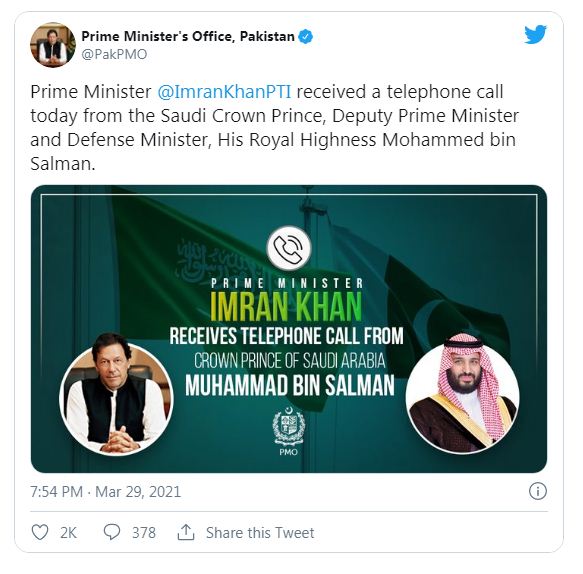
ISLAMABAD, MAR 30: Prime Minister Imran Khan on Monday received a telephone call from Saudi Crown Prince Mohammed bin Salman who invited the premier to visit Saudi Arabia. Both leaders discussed bilateral ties.
Meanwhile, the prime minister wrote a letter to Saudi royals, lauding their “Saudi Green Initiative and Green Middle East Initiative”.
According to the Prime Minister Office, the crown prince inquired about the prime minister’s health and wished him speedy recovery. PM Khan also inquired about the wellbeing of the crown prince who had recently undergone a surgical procedure.
The prime minister wrote: “It gives me immense pleasure to extend my best greetings and hope that Your Royal Highness is in good health and safe from the pandemic. I would like to convey deep respects and warm wishes for the Custodian of the Two Holy Mosques, King Salman Bin Abdulaziz.”
PM lauds kingdom’s green initiatives
Mr Khan added: “I am delighted to learn about Your Royal Highness’s plans for launching ‘Saudi Green Initiative’ as well as rallying the region for the larger ‘Green Middle East Initiative’ aimed at protecting the nature and planet.”

He said the two initiatives which, inter alia, included plantation of 10 billion trees in the kingdom and its further upscaling to 50 billion in the region as part of the Green Middle East Initiative, expansion of protected areas to more than 30 per cent, protection of marine and coastal environments and generation of 50pc of the kingdom’s energy from renewable by 2030, were highly commendable.
Mr Khan said the vision of Saudi leaders closely aligned with the government’s “Clean and Green Pakistan” initiative which was investing in nature-based solutions to address climate change impact in the country.
“After successfully planting one billion trees from 2014 to 2018, our ‘10 billion Tree Tsunami’ initiative is well under way across the whole country. We are also expanding our protected areas — over 15pc land and 10pc marine — by 2023. These initiatives have demonstrated that planting trees not only protects nature and restores ecosystem to fight climate change, but also expands eco-tourism and creates thousands of green jobs for the youth as well as local communities,” he added.
Prime Minister Khan said: “We are also committed to shifting our energy mix towards a clean and low carbon trajectory. Like the kingdom’s vision, we are targeting 60pc of our energy to be clean energy by 2030, which will require a major expansion of solar, wind and hydro power generation capacity in the country.
“Pakistan cherishes its cordial and brotherly relations with the Kingdom of Saudi Arabia and we would like to extend our support for Your Royal Highness’s excellent ‘Green’ initiatives. While our two countries maintain close cooperation on climate change issues at all multilateral forums, a meaningful and structural bilateral engagement can help advance our shared vision and create mutually beneficial opportunities for partnership. We would also be happy to share experience, knowledge and lessons from our nature-based approaches and initiatives.”
He said the challenge of climate change was one that called for greater international collaboration and a shared aspiration for sustainable development as the world had no choice but to tread this green pathway and define a new development paradigm for the 21st century. “I wholeheartedly appreciate Your Royal Highness’s efforts toward this transition,” he added.
The prime minister also conveyed best wishes for the royal highness’s good health and happiness, and for continued progress and prosperity of the people of Saudi Arabia.
Meanwhile, Pakistan High Commissioner to Bangladesh Imran Siddiqui called on the prime minister and briefed him on relations between the two countries. The prime minister directed the high commissioner to continue efforts to promote bilateral relations. He conveyed good wishes for the leadership and people of Bangladesh.
--------------------------------------------------
COURTESY DAWN NEWS
-----------

ISLAMABAD, MAR 30: Center for Global & Strategic Studies (CGSS), Islamabad is organizing an Online International Conference titled “Evolving Global Security Challenges in the Post-COVID World”. The conference aimed to discuss the transforming security paradigm in the context of new challenges of global security in the post-pandemic world. It will focus on the policy options at both the regional and the international levels to address the universal security threats including the non-traditional as well as the traditional threats.
Renowned subject experts from Pakistan, China, Turkey and Indonesia will participate as Guest Speakers, the details are as below:
- Mr. Tolga Sakman, Chairman, Center for Diplomatic Affairs & Political Studies (DIPAM), Istanbul, Turkey
Topic of Speech: Re-evaluating the international security architecture in Post-Covid19 era: Potential Areas and Policy Options for Eurasia
- Prof. Dr. Iram Khalid, Chairperson, Department of Political Science & IR, University of the Punjab, Lahore, Pakistan
Topic of Speech: The Impact of COVID-19 on Security Dynamics of Asia
- Dr. Shafiah F Muhibat, Director of International Relation, Center for Strategic and International Studies (CSIS), Jakarta, Indonesia
Topic of Speech: Security Challenges and Alignments in East Asia
- Dr Aiysha Safdar, Head of International Relations Department, Kinnaird College For Women University, Lahore, Pakistan
Topic of Speech: Redefining national security in context of Pakistan
- Dr. Adam Saud, Dean, Faculty of Humanities & Social Sciences, Bahria University, Islamabad, Pakistan
Topic of Speech: Shifting of focus from War on terror towards the strategic competition between US, China and Russia
- Mr. Shakeel Ahmed Ramay, Director, China Study Center, Sustainable Development Policy Institute (SDPI), Islamabad, Pakistan
Topic of Speech: Covid-19 pandemic reshaping the China-US competition
- Dr. Naheed S. Goraya, Assistant Professor, Centre for South Asian Studies, University of the Punjab, Lahore, Pakistan
Topic of Speech: Collaborative approach worldwide to counter Non-Traditional Security Threats
- Prof. Sun Lu, Associate Professor, School of Government & Public Affairs, Communication University of China, Beijing, China
Topic of Speech: China’s approach in context of rising Multi-polarity and the Emerging geopolitical environment
The Conference will be held on 31st March 2021 at
1200 hrs (Turkey Time)
1400 hrs (Pakistan Time)
1600 hrs (Indonesia Time)
1700 hrs (China Time)
You are requested to join us via Zoom Application.
The Zoom Meeting ID is: 863 6622 1090 Or Visit the Link : https://us02web.zoom.us/j/
Please find attached the Invitation Card, Speakers Profile & Topic of Speeches with the email.
Looking forward to your kind participation.
----------------------------------------------------------


COURTESY CGSS
-------------
Social Media
Search