Saturday, 19 June 2021

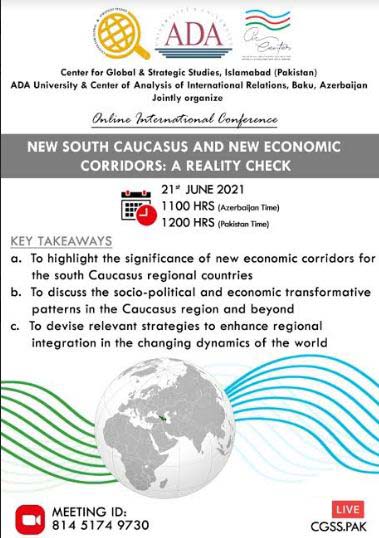
ISLAMABAD, JUN 19: Center for Global & Strategic Studies, Islamabad (Pakistan), ADA University & Center of Analysis of International Relations, Baku, Azerbaijan are jointly organizing an Online International Conference titled “New South Caucasus and New Economic Corridors: A Reality Check”.
The aim of the Conference is to highlight the opportunities and benefits associated with the new economic corridors and changing regional realities amid the new South Caucasus.
Key Takeaways
- To highlight the significance of new economic corridors for the south Caucasus regional countries
- To discuss the socio-political and economic transformative patterns in the Caucasus region and beyond
- To devise relevant strategies to enhance regional integration in the changing dynamics of the world
Renowned subject experts will participate as Guest Speakers, the details are as below:
- Mr. Fariz Ismailzade, Executive Vice-Rector, ADA University, Azerbaijan
Topic of Speech: South Caucasus and Central Asia: Opportunities under the Belt & Road Initiative
- Mr. Orxan Bagirov, Leading Advisor, Center of Analysis of International Relations, Azerbaijan
Topic of Speech: The Creation of Zangezur Corridor and Its Importance for the Development of Regional Cooperation
- Dr Mehmood-Ul-Hassan Khan, Member Board of Experts, Center for Global & Strategic Studies (CGSS), Islamabad, Pakistan
Topic of Speech: Strategic Importance of Zangezur Corridor and Expected Partnership with Pakistan
- Mr. Shareh Qazi, Lecturer, Department of Political Science, University of the Punjab, Lahore, Pakistan
Topic of Speech: New South Caucasus & Non-State Security Threat of Landmines
- Dr. Zarmina Baloch, Lecturer, Department of Political Science, Islamia College University of Peshawar, Pakistan
Topic of Speech: New South Caucasus: From Middle Power Doctrine to Regional Balancer
The Conference will be held on 21st June 2021 at
1100 hrs. (Azerbaijan Time)
1200 hrs. (Pakistan Time)
You are requested to join us via Zoom Application.
The Zoom Meeting ID is: 814 5174 9730 Or Visit the Link : https://us02web.zoom.us/j/
Please find attached the Invitation Card, Speakers Profile along with Topic of Speeches with the email.

Looking forward to your kind participation.
-------------------------------------------------------------------

ISLAMABAD, JUN 19: Pakistan has reaffirmed its pledge to fully implement 27 international conventions as part of its commitment to the European Union’s preferential trade arrangement, the Generalised Scheme of Preferences Plus (GSP+).
The commitment was conveyed twice this week — first at the meeting of Pakistan-European Union Joint Commission held on Wednesday, but whose joint declaration was issued two days later, and during a meeting between Foreign Minister Shah Mahmood Qureshi and EU High Representative for Foreign Affairs and Security Policy Josep Borrell on the sidelines of the Antalya Diplomacy Forum in Turkey on Friday.
The Foreign Office in a statement on Mr Qureshi’s meeting with Mr Borrell said the foreign minister “reiterated Pakistan’s firm commitment towards the GSP Plus preferential trade regime and effective implementation of the twenty-seven related international conventions”.
Moreover, the joint statement on the Pak-EU Joint Commission meeting said: “The EU and Pakistan agreed to enhance bilateral trade, including by addressing issues that are hampering trade and investment, improving the business climate, and Pakistan’s efforts towards full implementation of the 27 international conventions stipulated under the EU’s unilateral trade preferences scheme, the Generalized Scheme of Preferences Plus (GSP+).”
Assurance conveyed to EU during Qureshi’s meeting with Borrell in Turkey
“Pakistan acknowledged the extension of its GSP+ status as a mutually rewarding step and affirmed its full commitment to fulfil its obligations under the GSP+,” it added.
The GSP+ is a special trading arrangement that provides developing countries preferential access to the European markets by slashing tariffs to zero on most of the products.
The countries benefiting from the scheme have to implement 27 international conventions related to human rights, labour rights, protection of the environment and good governance.
The EU describes it as a “special incentive arrangement” for sustainable development and good governance.
Mr Qureshi said the GSP+ had played an important role in the growth of trade between the two sides.
The EU is Pakistan’s second most important trading partner. Pakistan’s exports to EU were about 5.5 billion euros in 2020, which accounted for 28 per cent of the country’s total exports.
Pakistan, which has ratified all 27 conventions, has been benefiting from the GSP+ status since January 2014. Its GSP+ status was extended for another two years in March 2020.
Pakistan’s progress on the implementation of the 27 conventions has been mixed. Despite introduction of domestic legislation for the implementation of these conventions, various quarters have been raising questions over their implementation.
The EU has on number of occasions raised concerns about the overall situation of press freedom, the situation of civil society organisations and human rights defenders, gender equality, minority rights, and the death penalty.
“Pakistan informed about developments concerning the Journalist Protection Bill, the Forced or Involuntary Disappearance Bill and the Anti-Torture Law,” the joint declaration said.
The EU raised concerns regarding the death penalty and the abuse of blasphemy laws, it added.
APP adds: Mr Qureshi and Mr Borrell discussed the entire spectrum of Pakistan-EU relations as well as global and regional situation, including the Afghan peace process and Indian Illegally Occupied Jammu and Kashmir.
The two also exchanged views on the Covid-19 pandemic.
Appreciating the EU’s support, the foreign minister delineated the steps taken by Pakistan to effectively tackle the situation.
Mr Qureshi also briefed Mr Borrell on Pakistan’s progress towards the comprehensive implementation of the Financial Action Task Force action plan and sought the EU’s support in the review process.
He emphasized that at a time of rising Islamophobia, racism and populism, the international community must show a common resolve against xenophobia, intolerance and incitement to violence on the basis of religion or belief.
In the regional context, the foreign minister briefed on Pakistan’s contributions to the Afghan peace process, and stressed that the conflict could only be settled through an Afghan-led and Afghan-owned political process.
Both sides urged all the Afghan factions to seize the historic opportunity presented by the peace process to settle the conflict through political means.
----------------------------------------------------------
COURTESY DAWN NEWS
-----------
Friday, 18 June 2021

BAKU, JUN 18: The visiting delegation of the Pakistan Air Force (PAF) led by Air Vice Marshal Tariq Zia met the Deputy Minister of Defense of the Republic of Azerbaijan and the Commander of the Air Force Lieutenant General Ramiz Tahirov in Baku on Thursday.
In the meeting, the two sides
expressed satisfaction with the development of Azerbaijani-Pakistani relations
and the level of strategic partnership.
The sides also discussed the prospects for the development of cooperation between the Air Forces of Azerbaijan and Pakistan in the military, military-educational and military-technical spheres, as well as other issues of mutual interest.
Expressing satisfaction with the
education of Azerbaijani military pilots at the Pakistan Air Force Academy, Lt
General Ramiz Tahirov stressed that the development of cooperation in the
sphere of military aviation and relations between the Air Forces of the two
Countries, contributes to further strengthening the combat capability of our
armies.
The Head of the PAF delegation
congratulated the Azerbaijani people on the victory in the Patriotic War,
wished the mercy to the souls of all servicemen and civilians who died as Shehids
and healing to the wounded.
Earlier upon its arrival, the PAF delegation visited the Alley of Shehids (Martyrs) laid wreaths and flowers at the graves of our compatriots who died as Shehids for the independence and territorial integrity of the country, and paid tribute to their memory.
------------------------------------------------------------------------
COURTESY dndnews
-------------
Thursday, 17 June 2021

Shazia Anwer Cheema
All is set for establishing
Research Hubs for promotion of Sufism, science, and technology all over Punjab,
and first of its kind is already inaugurated in Lahore.
The name of Center is after
Moroccan Sufi Abu al-Hasan ash-Shadhili who is also known as Sheikh al-Shadhili.
He was the founder of the Shadhili Sufi order.
In the subcontinent, popular Sufi
Silsalas (Orders) are Chishti Order, Naqshbandi Order, and Qadiriyya
Order. While Shadhili Order has been popular
in the Maghreb and Egypt.
Available areas of work of this center include research on Islam, Sufism, religious thought, interfaith harmony, and modern sciences like science and technology.
The center will be linked with
shelter homes, child protection bureaus, prisons, particularly women and
juvenile jails, schools, colleges, universities, public, private, and religious
educational institutions. The center would provide access to international
libraries like Jstor, Oxford, and Cambridge.
This is pleasant news that such 380 degrees Center would be operational in Lahore offering course and degrees to masters and Ph.D. students.
Teaching religious thoughts interfaith harmony, theology, the competitive study of religions can be found in several universities of Punjab but this Center will also offer degrees in Sufism.
For my understanding can Sufism
be taught in a semestral system, being divided into module/credit hours? I surf
around and find few universities having Sufism Departments, mainly Islamic
studies and Sufism.
While looking for a course outline I find out that only the theoretical background of Sufism is being taught.
The prominent books in Sufism
tradition and important figures introduction has been given. So for my
knowledge is concerns Sufism is a journey that sometimes finds a destination
and most of the time this journey is endless because Truth is not simple to
examine if found. Sufi goes through the process of Kashf (unveiling) in this
journey.
Kashf defines the state of experiencing an individual divine disclosure of Truth after ascending through spiritual struggles, and unveiling what has not been see-through simple practicing of religion.
Kashf is etymologically linked to Mukashafa (disclosure). Disclosure is knowledge of things unseen behind the veils. The veil is blurriness between the accepted truth and the real truth.
Sufi believes that whatever truth
we know around us is Approximate Truth while the Truth is hidden and only
purified hearts can find it.
There is no fixed rule or process
to find Truth in Sufism. Different Sufis had explained different stages and
processes.
Truth is found after going through stages (Manazal) and stations (Paraho or Astana), different schools of thought have marked different kinds of Manazal. Ishq (love) is the first requirement for the exploration of truth and Ishq needs total submission to beloved.
Most important and acceptable
stages starting from Tawba (Repentance), it goes through different stations of
the inner voyage including the Wara’ (Watchfulness), Zuhd (Renunciation), Faqr
(Poverty), Ṣabr (Patience), Tawakkul (Trust), Riḍā (Satisfaction), Comparison
to Ḥāl (Spiritual State) and Qualifications (Wasf— Maqqm–Station).
How can mentioned stages of
Sufism be taught and attain in a span of two, three or even five years? If yes, then how?
How one can learn in a classroom
setting Tawabah repentance, how stages and components of repentance could be
examined afterward?
To my understanding Sufism is the training of a lifetime, no institution can make one a Sufi, second for adhering to Sufism one does not need a controlled and contrived setting.
My concern is that we are far
away from the good old days where acceptance level was equal to being humane.
Millions have been spent to make us what we are today, intolerant, obsessive, and impulsive and tons of knowledge has been poured into our brains to make us anything but unlike a Sufi during the last forty-plus years.
Who is going to tie the bell now
by claiming that Sufism is a better institution? Who will debate about Treqat,
and Shareyat? Who will put his/her head
under the sword of wahtat ul shahood and wahtat ul wajood?
Even historically Sufism is
considered an Ajmi Ideology and always parallel and sometimes crossing to
another Islamic sect.
I have no doubt we need Sufism to simmer down but I am on square one again; how? If by opening a university or academy, as an academic myself I am sure that Sufism cannot be taught in modules, in prescribed time with a defined outline.
South Asian society is always
considered the land of Sufis and Darvishes, this is another story of how it has
been changed systematically over the last few decades.
In my humble opinion, we are far away from the point of becoming Sufis, Faqr and Darvish have been replaced with imposition and impatience. If somehow it could be reversed and in my lifetime I will be the luckiest person.
Note: The writer Shazia Cheema is an analyst writing for national and international media outlets. She can be reached at her: Twitter @ShaziaAnwerCh Email: shaziaanwer@yahoo.com
---------------------------------------------------------

The LCCI IT Awards were held at
Aiwan-e-Sadr, Islamabad, and aims to appreciate the efforts of Pakistan’s
information technology companies and their contributions towards the well-being
of Pakistan's economy.
LCCI recognized Systems Limited’s
dedication, innovation, and continuous growth in the IT industry. The chamber
appreciated all the hard work that Pakistan’s leading technology organization
is doing to strengthen the digital landscape in this country.
Systems Limited maintains a keen
focus on innovation, reinvention and meaningful investments in startups and
collaboration with organizations such as TCF to pave a pathway of growth and
digital innovation for future generations. President IT Award by LCCI is a
testament to the company’s dedication to the IT sector.
Previously, System Limited was awarded Forbes Asia’s Best Under A Billion and PSEB’s Top IT Exporter 2019 and Top IT Consultancy Services Exporter.
These achievements, according to the company’s leadership, are a clear representation of the talent that makes it possible for the Systems.
The company acknowledges the importance of attracting and nurturing the industry’s brightest minds and takes pride in being one of Pakistan’s employee-centric companies.
The LCCI Award and other
accolades are a continued recognition of the dedication of Systems Limited’s
highly skilled workforce.
Asif Peer, CEO/Managing Director at Systems, expressed his gratitude on this auspicious occasion, “I am extremely humbled and thankful to the President of Pakistan, his grace, Dr. Arif Alvi, the government, and the Lahore Chamber of Commerce & Industry (LCCI) for this auspicious recognition awarded to Systems Limited. I want to extend my gratitude to the entire Systems team and leadership.
I ensure you that we are
collectively working towards creating more employment opportunities in
Pakistan, growing our global footprint, and expanding our workforce and
offerings.” He recognized its employees as the mainstay for this noble
achievement.
“The investment opportunities are growing in Pakistan, especially for the IT industry. Credit goes to the government for focusing on ICT as it has resulted in a growth in IT exports, and the entire nation is benefitting.
I would like to thank the government for extending its support for the startup ecosystem; we look forward to working closely with the government in this great initiative of supporting startups and incubations.
The IT industry is attracting Venture Capitalists, investing in the industry, which is most likely to benefit the domestic business and result in an increased influx of foreign exchange.
The government's attention to the digitization of the domestic industries is very crucial, especially in the capacity building for SMEs to have different solutions.
I would also like to extend my
gratitude to our colleagues, stakeholders, and partners”, said Asif Peer.
Asif Akram, COO at Systems Limited, received the accolade and stated, “It is humbling to be at the receiving end of this huge honor, but we must highlight our end goal, which is the advancement and well-being of our economy."
He further shared, “Together, we will continue to strive to make the IT industry one of the biggest Pakistani industries and go all-out to introduce our country as the most cost-effective and resilient country for outsourcing IT-enabled business processes.”
-------------------------------------------------
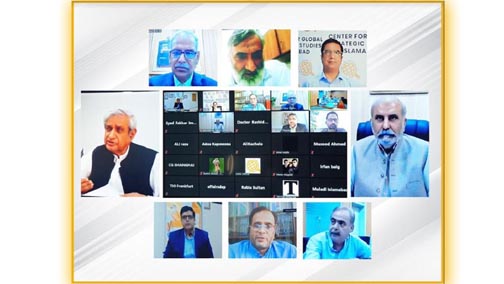
ISLAMABAD, JUN 17: An online conference on the topic, “Dynamics of Potential Mango Value Chain in Pakistan: Benefits for Exploring New Markets”, was jointly organized by the Center for Global & Strategic Studies (CGSS), Islamabad, M Nawaz Shareef (MNS) University of Agriculture, Multan and Mango Research Institute, Multan.
The aim of the conference was to explore new potential markets for mango trade between Pakistan and various countries.
Furthermore, the trading purpose envisaged discovering new overtures such as; post-harvest mango technology, enhancing Pakistan's mango trade and production, to understand emerging trade-market trends in Central Asia, Asia Pacific and beyond.
Various experts were invited to
suggest policy guidelines to enhance trade linkages and curtail market-business
challenges regarding the mango supply chain.
Fakher Imam, Federal Minister for Food Security & Research, Government of Pakistan was the Chief Guest of the Conference.
He stated that the agro-economy of Pakistan has always had a strategic outlook. From five of our crops; maize, rice and sugarcane have done extremely well.
The Mango industry has 66% of mangoes grown in Punjab. He explained that there are four different types of treatments by application of which we can reach the high-end markets from the low-end ones. Most of our mangoes go to 42 countries which can now be outreached to 60 countries.
Hence, an overall improvement is required to upgrade our major mango production clusters. Therefore, DNA –tested mango varieties should be cultivated in the country as the new scientific method, new packaging methods, new organic cultivation procedures-pest and fertilizer free zones.
This would enable Pakistan to
meet the health standards of the high-end and sophisticated markets,
specifically the Chinese markets. For this purpose, Pakistan has inherent
research systems for grafted mangoes, thus, implying new research vistas, to
cope with trade challenges.
Hussain Jahania Gardezi, Provincial Minister for Agriculture Punjab, Government of Pakistan was the Guest of Honour of the Conference.
He stated that in a country like Pakistan, with various types of weathers and soil types, mango is our national fruit grown along with different fruits.
Mango has relevancy with old traditions of gift exchanges which have now become popular in the corporate sectors.
According to him, Pakistan is the fourth-largest producer of mangoes i.e. 1.8 million tons. But, now with evolving trade mechanisms, Pakistan needs to grow its preservation and canning industries, whereas, procedures should be met with international hygiene standards.
He stated that the mango growers should practice healthier mango cultivation with pure organic methods to facilitate chemical-free production.
Furthermore, the value chains
should become modern and technological advanced to add sustainability to mango
shell life. He shared the Government’s mission that by applying high-tech
improvements Pakistan should reach one billion dollar revenue in the
international markets.
Prof. Dr. Asif Ali, Vice-Chancellor, MNS University of Agriculture, Multanstated that positive efforts are in progress to upgrade mango exports.
But, facilitation and efficiency are the two requisites to improve trade. Furthermore, more mango festivals should be upheld to raise the commercial value of Pakistani mangoes.
He shared his experiencing of the mango production sessions and emphasized that marketing should be the future focus to facilitate growers and exporters.
Furthermore, new methods like dry
mango production, mango breeding, DNA testing and relevant should become
pre-requisites of our trade chains and future endeavours.
Maj. Tariq Khan, Progressive Mango Growers Association, (LutfabadMango Farms Multan) delivered his speech on the topic, “Mango production: Current Trends and Future Prospects”. He stated that Pakistan has been wanting to add value to the mangoes for a long.
Hence, opting for the export. But, due to climate change, mango production is being impacted. Last year due to COVID Pakistani exporters faced a regression due to restriction of land and sea routes, whereas air transport too became restricted.
He added that the safest mango products are exported from Pakistan. Yet, our biggest market is the United Kingdom.
Nowadays as we are pitching new tariff regimes our mangoes are being exported in Central Asian countries and beyond.
He mentioned new potential
markets stating that Iran is one of our potential markets. Furthermore, our
academia is now strong enough to increase the mango shell life to cope up with
the sea routes distances.
Prof. Dr Amanullah Malik Group Leader, Postharvest Research and Training Center, University of Agriculture, Faisalabad stated that over a dozen varieties of mangoes in Pakistan, Sindhri, Sammar Bahisht Chaunsa and Sufaid Chaunsa are the most popular ones.
Dr. Amanullah talked about the postharvest supply chain challenges. Some major challenges include; maturity assessment, sap management, phytosanitary treatments for market access, packaging and limited shelf life.
According to him, quality consciousness should be the focus of mango production in the grower cluster markets.
Therefore, some projects like the Code of Practices were operationalized to meet international standards and build production infrastructure.
Furthermore, domestic level staff
training should be adopted to reform basic level practices with the adoption of
essential standard operating procedures(SOPs), aided with advanced scientific
procedures to kill pesticides and residues. Some of his suggestions included;
modern on-farm infrastructure, 1-MCP technology, PurFresh and R & D support
for capacity building of mangoes production.
Mr. Waheed Ahmad, Leading fruit exporter and President of the Pakistan Fruit Exporters Association spoke on the topic, "Mango Export from Pakistan: Opportunities& Challenges.”
According to him All Pakistan Fruit & Vegetable Exporters, Importers & Merchants Association (PFVA) aims to achieve the horticulture vision by 2030.
This includes; offering the premium price of 50% for value product, a ban on wooden crates etc. Pakistan now is the leading country to export mango varieties.
The country is 6th in mango production and 5th in global export. The reason for so is that 90% of exports are focused on few countries.
He added that the best export opportunity for Pakistan is the month of July and August where USA, Japan, China, South Korea and Australia can best be new potential markets.
He focused that Pakistan should specifically facilitate the demand of China to import good-tasting mangoes post-June yearly. Furthermore, value addition, whole sailing, processing, marketing should have revised policies and mechanisms.
His speech covered challenges
i.e. mango production and export volume gap, climate changes, poor harvesting,
untrained labour, absence of food chain and yield gaps-in which Pakistan stands
in 19th position.
Mr. Khalid Taimur Akram, Executive Director, CGSS spoke on “Importance of International Mango Trade." According to him, Mangoes being Pakistan's second-largest fruit export after citrus fruits, mangoes are majorly grown in two provinces of Punjab in 54,000 hectares and Sindh 46,000 lands.
He stated that the year 2020 noted a decline of almost 35 to 40 mango exports due to the closure of land trade routes and other restrictions.
The best records are known to have earned over $90 million via mango exports for the country. Furthermore, while suggesting robust trade mechanisms, Mr. Khalid added that we need to cope up with the post-pandemic challenges, so that timely mechanisms and opportunities would regulate the normalcy in the foreign trading platforms.
Hence, cooperation and
collaboration in scientific, as well as academic domains are essential to
sustain Pakistan’s trade and progressive graph in future.
The Conference was attended by the diplomats from various countries including Azerbaijan, Bangladesh, Canada, China, Germany, Indonesia, Japan, Malaysia, Oman Russia, Tajikistan, Ukraine, and Uzbekistan.
The session was moderated by Dr. Mubashir Mehdi, Assistant Professor Institute of Business Management Sciences, University of Agriculture Faisalabad and was attended by 100 participants on Zoom and 150 people from across the world watched the Conference live.
-----------------------------------------------------------

ISLAMABAD, JUN 17: The Ambassador of China to Pakistan Nong Rong visited the Naval Headquarters in Islamabad on Thursday and held a meeting with the Chief of the Naval Staff (CNS) Admiral Muhammad Amjad Khan Niazi.
During the meeting, matters pertaining to Pakistan-China bilateral collaboration, mutual interest, and regional security situation came under discussion.
The two dignitaries expressed
commitment for further enhancement of relations between the two countries and
maritime security forces in particular.
The Naval Chief apprised the
Chinese ambassador on the role of the Pakistan Navy regarding maritime
security.
The Chinese ambassador acknowledged the efforts of the Pakistan Navy regarding regional maritime security.
------------------------------------------
COURTESY dndnews
------------

ISLAMABAD, JUN 17: A Roundtable Discussion on "Illicit Tobacco Trade: Need for Implementation of Law & Regulatory Regimes" was organized by Center for Global and Strategic Studies (CGSS), Islamabad.
The discussion commenced with the opening remarks of Major General Hafiz Masroor Ahmed (Retd), Vice President, Center for Global and Strategic Studies (CGSS), Islamabad.
He stated that, we have gathered to discuss an important issue.
A lot of studies have been conducted on this issue and its shows that the impact of illicit tobacco trade is enormous in terms of revenue.

In our current policy, many new initiatives are being
incorporated to tackle this issue.
Maryam Raza, Research Associate, CGSS gave an introductory presentation on the subject.
She said that according to a report by IPSOS there are five major sectors in Pakistan due to which the tax evasion ratio is high. 65% of all tyres in Pakistan are smuggled. Small traders who hold 40-50% market share contribute massively to tax evasion.
Real estate in Pakistan is where the tax evaded/black money gets parked. Counterfeit medical drugs and illegally smuggled medicines have been the biggest challenge for law-enforcement agencies to combat.
Tax evasion is carried out
through the illegal trade of tobacco and has three main strands, each having
its own estimation of losses to national exchequer and additional violations of
several other laws in the country.
Mohammad Jehanzeb Khan, Deputy Chairman, Planning Commission of Pakistan was the Guest of Honor at the occasion. Hecommended CGSS for organizing this timely discussion. He stated that today, we will bring to spotlight, the important public policy matters.
He stated that being multi dimensional, this matter is of great significance. He stated that there have been a lot of campaigns to highlight this issue at both national and international level. The aim of these campaigns was to limit the use of tobacco rather to completely eliminate it.
He further added that in recent times, we have not seen any significant decrease in the in the illicit tobacco trade. The key element and question is the ability to enforce and curb tax evasion and illicit tobacco availability and the enforcement structure of the country.
Other mechanisms other than
pricing are also being worked out to tackle this issue. In terms of Pakistan,
the policy must be relooked in a proper structured manner and must be
long-term.
Mr. Zahid Latif, Chairman, Islamabad Stock Exchange stated that only two tobacco companies pay 98 percent of total tax tobacco collection.
The remaining 40 percent
companies pay a meagre two percent tax. In last twenty years, nothing concrete
have been done to curb this issue. This subject leads to subjects like smuggling
and loss of revenue.
Dr. Ikram Ghani, Former Chairman
Pakistan Tobacco Board stated that there is no denying that in Pakistan, today
illicit tobacco trade is on the rise. The price differential between the duty
paid and local NDP cigarettes is leading to a further inclination towards
consumption of illegally produced cigarettes. Today 40% of cigarettes sold in
the country are illicit.
Prof. Dr. Saleem Mazhar, Pro-Vice Chancellor, University of the Punjab, Lahore stated that several awareness campaigns must be organized to highlight this issue at the macro level. Different workshops and sessions must be organized with maximum participation of the stakeholders.
Furthermore, cooperation and
collaboration amongst the stakeholders is very important in this regard.
Dr. Aman Ullah, Professor Law
College, University of the Punjab, Lahore stated that tobacco is different from
other trades. In future, for good governance we need to control illegal trade.
We are facing issues with reference to FATA. We need to replicate success
models.
Ms. Fatima Azim, Senior Vice
President, Islamabad Chamber of Commerce and Industry stated that one major
issue is how government is dealing with the illicit trade situation. There is
need to absorb awareness and know the consequences. Discouragement should be
made a key.
Mr. Tahir Alam, Former Inspector General of Police, Islamabad discussed in detail the Pakistan Tobacco Board Ordinance 1968. He explained the laws and implications.
He stated that laws related to
counterfeiting cigarettes mostly legal actions are required. Every tobacco
grower should be registered and there must be strict monitoring by the Pakistan
Tobacco Board. There must be intelligence squads to collect information on tac
avoiders, smugglers and counterfeit of cigarettes.
Dr. Mehmood Rehmani, Assistant Professor, Department of Business Administration, University of Sialkot stated that usually different reports give different statistics.
We need to critically evaluate the issue and engage academia. Engaging academia will also enable us to understand the hurdles in implementation.
We must have mobile applications
where the complaints can be registered. We must ensure the health of the youth
is being safeguarded.
Prof Sohail Shahzad, Former Vice
Chancellor, Hazara University and Prof Law College, University of Peshawar
stated that according to his research regulation of governance must be
seriously implemented keeping in view the health priority.
Mr. Tariq Bakhtawar, Former Director Anti-Money Laundering at the Securities and Exchange Commission of Pakistan stated that we need to have effective resource and implementation mechanism.
We have done good work in terms
of establishing the framework but implementation is also important. Our legal
framework is in bits and pieces and we need a strong implementation regime.
Barrister Waqas Aziz Qureshi, Senior Law Expert & Managing Partner, Transact Advisory Service stated that in terms of Pakistan, the problem is in the implementation of the law.
Radical problem needs radical solution. We need to keep check on plantation of tobacco and preharvest stage.
Cigarette manufacturers must be
known from grey and black markets. He stated that we need to have robust
intelligence system for smuggling and taxation.
Mian Abdul Rauf, Former Advocate General Islamabad High Court stated that there are various factors but one has to go for a more comprehensive legislation and regulatory regime.
Regulatory regimes needs
efficiency and implementation of laws. There is a difficulty to criminalize before
going through SRO’s.
Prof. Dr. Shabbir Ahmed, Director, Area Study Center (Russia, China and Central Asia), University of Peshawarstated that it is discouraging to know that illicit trade is near 50% in Pakistan market.
In Pakistan, our law enforcement
agencies have 90% focus is on the counterfeit and only 10% is on the illicit
trade. Therefore, from production declaration to raw material, the only
solution is the rule of law.
Mr. Kamal Ud Din Tipu, Former Inspector General, Islamabad Police stated that we need to have a greater emphasis on the law enforcement.
We need to understand sensitivities that cause repercussions if law is not enforced in a balanced manner.
In Pakistan, we need to look into
different dynamics of tobacco law enforcement and understand the cultures that
regulate legal and illicit trade. For this, suitable punishment between
criminalization and decriminalization should be implemented.
Mr. Ashfaq Ahmed Tola, Founder and President of Tola Associates stated we need to ponder upon the net sum of loss the country holds on account of illicit tobacco trade. He highlighted a few major reasons that have cultivated this culture in Pakistan.
First is the domestic setup
capacity of tobacco on local level. Second is the smuggling culture. He shared
some ideas on tracing and tracking of illegal trading. Furthermore, he
emphasized that technical teams are required to be engaged.
Dr. Yusuf Zafar, Former Chairman,
Pakistan Research Council (PARC) presented concluding remarks. In Pakistan,
there is a dire need to focus on implementation and consumer acts.
The roundtable discussion was moderated by Ms. Palwasha Nawaz, Project Executive, CGSS, Islamabad and was attended by approximately 35 participants.
------------------------------------------------------------
Wednesday, 16 June 2021

ISLAMABAD, JUN 16: The Ministry of Information Technology and Telecommunication, in collaboration with Huawei Technologies Pakistan launched the much awaited ‘1000 Government Employee Training Program’ in a virtual event attended by the Federal Secretary of IT & Telecommunication, Dr. Sohail Rajput, Huawei Middle East VP, Mr. Spacelee, CTO Huawei Enterprise Solutions Middle East, Mr. Faisal Ameer Malik along with Senior Managers and Directors from MoITT, NTC, NITB, NADRA and other representatives from both collaborating organizations.
According to the program, a 1000 of the ministries, officers would be given ICT knowledge training by Huawei’s industry leading teams in different batches to help increase their skills in the fields of artificial intelligence, 5G , IoT, cloud technology, big data, block chain, and communications technology.

A total of 1000 government employees are expected to have been trained by December. The first batch of training starts today in a 5 day intensive training program that will assist them in developing a more robust understanding of technological trends.
This will be achieved by virtual lectures and demonstrations during the course of the week.
The training program has long been in the works with subsequent meetings between the minister for IT and Telecommunication, Amin Ul Haque and President of Huawei Middle East Region, Charles Yang back in March, after which the Huawei Delegation led by Mr. Spacelee met with President Arif Alvi who called for promoting knowledge-economy and digitalization of Government organizations to enhance the efficiency of work and service delivery.
During the opening ceremony, Federal Secretary of IT stated, “Huawei is one of the leading technology giants in the world and has a large footprint in Pakistan.
We can all agree that artificial intelligence, big data etc. is the future. With technical support from the state of the art companies like Huawei, we can train our youth to introduce digitization in Pakistan, this training being a crucial step in that direction. ”
Huawei Middle East VP, Mr. Spacelee, further reiterated, “We are very glad to collaborate with the Ministry of IT and Telecommunication for this training program, to provide training in areas such as artificial intelligence, cloud technology, big data, block chain, and communications technology.
E-governance needs skilled ICT government staff and can be considered one of the most important pillars of the Digital Pakistan Initiative.”
With ICT technologies developing quickly and becoming integrated into more and more aspects, the digital economy has become an innovating and wide-reaching economy. Digital transformation has become a necessity and a call to action for many countries.
------------------------------------------------------------------------------

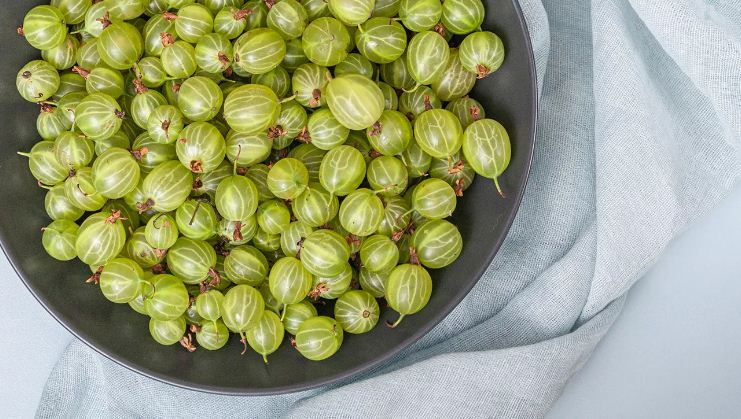
Also known as Indian gooseberry, amla is a type of tree native to Asia.
The tree is known for its small green fruits, which have a unique flavor often described as sour, bitter, and astringent.
Amla fruit is often enjoyed pickled or candied. It’s also sometimes sold as a powdered supplement or consumed as a juice for a quick and convenient way to squeeze some extra nutrients into your diet.
Amla juice is not only versatile and delicious but also highly nutritious and associated with a variety of health benefits.
Here are 6 of the top benefits of amla juice.
1. Promotes immune
function
Amla juice is a great source of vitamin C, which is a
water-soluble vitamin that acts as an antioxidant (1Trusted Source).
In fact, according to one review, amla is one of the richest
sources of vitamin C, packing 600–700 mg of vitamin C into each fruit (2Trusted
Source).
In addition to protecting the cells against oxidative stress,
vitamin C can enhance immune cell function (3Trusted Source).
According to one review of animal and human studies, vitamin
C could help prevent certain types of infections and may even shorten the
duration of the common cold when consumed regularly (4Trusted Source).
One older animal study also found that administering large
amounts of amla extract to mice helped protect against oxidative stress and
cell damage caused by arsenic (5Trusted Source).
However, more research is needed to determine how amla juice
may affect immune health in humans.
SUMMARY
Amla juice is a great source of vitamin C, an important
micronutrient that may boost immune function. One animal study also found that
it helped protect against oxidative stress, but more research in humans is
needed.
2. Enhances liver
health
Although research in humans is limited, some promising animal
studies suggest that amla juice could help improve liver function.
In one animal study, feeding amla to rats on a high fructose
diet increased levels of several key proteins involved in metabolism, which
could help prevent fructose-induced fatty liver disease (6Trusted Source).
Another animal study observed similar findings, noting that
amla extract reduced body weight and belly fat while improving fatty liver
disease in rats on a high fat diet (7Trusted Source).
Amla juice is also rich in antioxidants and possesses
powerful anti-inflammatory properties, both of which could be beneficial for
liver health as well (8Trusted Source, 9Trusted Source).
SUMMARY
Some animal studies have found that amla juice could support
liver health, which may be due to its antioxidant content and anti-inflammatory
properties.
3. Supports healthy
digestion
Interestingly, some research shows that amla juice could
offer several benefits for digestive health.
For example, one study including 68 people with
gastroesophageal reflux disease (GERD) showed that taking two 500-mg tablets of
amla extract twice daily for 4 weeks led to significant reductions in the
severity and frequency of heartburn and regurgitation (10Trusted Source).
Another 2011 animal study found that amla fruit has
antidiarrheal properties and may prevent muscle spasms, which could help treat
stomach cramps and discomfort (11Trusted Source, 12).
Several older animal studies also show that amla extract may
help heal and prevent stomach ulcers, which may be due to its antioxidant
content (13, 14Trusted Source, 15Trusted Source).
Further studies are needed to evaluate whether amla juice
specifically affects digestive health in humans.
SUMMARY
Animal studies show that amla could help treat and prevent
several digestive issues, including GERD, diarrhea, and stomach ulcers.
4. Promotes heart
health
Multiple studies suggest that amla juice may improve several
aspects of heart health.
In one study, consuming 500 mg of amla extract twice daily
for 12 weeks reduced triglyceride, total cholesterol, and LDL (bad) cholesterol
levels in 98 people with abnormal blood lipid levels (16Trusted Source).
What’s more, those who consumed amla extract experienced a
39% reduction in the atherogenic index of the plasma compared with a control
group. The atherogenic index is used to measure the risk of excess cholesterol
buildup in the arteries (16Trusted Source).
Another small study found that supplementing with amla
extract for 12 weeks improved several risk factors for heart disease in 15
adults with overweight or obesity, leading to a reduction in cholesterol levels
and inflammation (17Trusted Source).
Plus, some studies have shown that amla extract may decrease
blood pressure, which is another key risk factor for heart disease (18Trusted
Source, 19Trusted Source, 20Trusted Source).
However, keep in mind that these studies evaluate the effects
of highly concentrated amla extract doses rather than amla juice itself.
Therefore, more studies should be conducted to determine whether amla juice
offers similar benefits for heart health.
SUMMARY
Amla extract may reduce several risk factors for heart
disease, including cholesterol, triglyceride, and blood pressure levels, as
well as inflammation.
5. May increase hair
growth
Amla is often used to stimulate hair growth and protect
against hair loss.
In one study in 42 people with hair loss, applying a serum
comprising amla and other ingredients like coconut water and selenium to the
hair daily for 90 days led to significant improvements in hair growth and
density (21Trusted Source).
Another older study found that amla blocked a specific enzyme
involved in hair loss (22Trusted Source).
According to one test-tube study, amla extract could
stimulate hair growth by promoting the proliferation of specific cells in hair
follicles (23).
While it’s unclear whether drinking amla juice may also help
boost hair growth, it contains several nutrients that may be beneficial,
including antioxidants and vitamin C (24Trusted Source).
Still, more research is needed to understand how drinking amla
juice affects hair health.
SUMMARY
Amla extract could help prevent hair loss and increase hair
growth by blocking the activity of a specific enzyme and promoting the
proliferation of certain hair follicle cells.
6. Improves kidney
health
Likely due to amla juice’s antioxidant content, research
shows that it may support kidney health.
For instance, one animal study showed that administering amla
extract to rats helped protect against kidney damage and preserve kidney
function (25Trusted Source).
Similarly, another older animal study showed that amla
extract helped prevent age-related kidney dysfunction by reducing oxidative
stress (26Trusted Source).
Furthermore, one animal study found that amla extract helped
normalize kidney function and increase antioxidant status in rats given a
medication to induce kidney toxicity (27Trusted Source).
Additional studies are required to determine how drinking
amla juice in normal food amounts may affect human kidney function.
SUMMARY
Animal studies have shown that amla extract helps protect
against kidney damage and preserve kidney function.
How to make amla juice
Amla juice is easy to make at home and requires just a few
simple ingredients.
To get started, chop up 2–4 Indian gooseberries and add them
to a blender, along with 1–2 cups (250–500 mL) of water.
You can also mix in other ingredients, such as ginger, black
pepper, honey, or sea salt.
Next, blend all ingredients thoroughly, use a strainer to
filter the liquid and remove any pulp, and serve.
If you’re having trouble finding amla fruit, you can also buy
premade amla juice from many online retailers and specialty stores.
For best results, be sure to look for a variety that’s free
of added sugar, artificial flavors, and preservatives.
SUMMARY
You can easily make amla juice at home or purchase it premade
from many online retailers and specialty stores.
The bottom line
Amla juice is highly nutritious and has been linked to
several impressive health benefits.
In particular, studies suggest that it may improve kidney,
liver, and heart health, enhance immune function and hair growth, and promote
digestive health.
Plus, amla juice is delicious and easy to prepare at home,
making it a great addition to a healthy diet.
--------------------------------------------
COURTESY healthline
-----------------
Social Media
Search