Saturday, 14 August 2021

- Pakistan is celebrating its 75th Independence Day today.
- The main flag-hoisting ceremony was held at the President House.
- All major public and private buildings have been decorated to mark the big day.
ISLAMABAD, AUG 14: The Pakistani nation is celebrating 75th Independence Day today with traditional zeal and enthusiasm with special activities to highlight the struggle of our forefathers and national heroes for acquiring a separate homeland.
The day dawned with special prayers and a 31-gun salute in the federal capital and a 21-gun salute at all provincial capitals. Special prayers were offered in mosques at dawn for peace, solidarity, and prosperity of the country.
The main flag-hoisting ceremony took place at the President House wh President Arif Alvi was the chief guest. After the flag-hoisting President Alvi addressed the nation.
National songs and the Kalam-e-Iqbal were presented during the ceremony.
Different public and private departments are holding special functions and activities including seminars, discussion programmes, photographic exhibitions, painting, poetry, national songs, and debate competitions with the focus on acknowledging the contributions of leaders of the Pakistan Movement and sacrifices of national heroes.
All the major roads and avenues of the federal capital, like other cities, have been decorated with flags, banners, and buntings to present a festive look.
The major public and private buildings in the city have also been illuminated to mark this important occasion.
The Islamabad Capital Territory Police as well as provincial governments have finalized traffic management plans for the convenience and safety of the general public.
Literary and cultural organizations have also chalked out some programmes to mark the day.
-----------------------------------------------------
COURTESY GEO NEWS
------------------

KABUL, AUG 14: After seizing four more provincial capitals in a lightning offensive that took them closer to Kabul, the Taliban completed their sweep of Afghanistan’s south on Friday, in the process also taking into custody a well-known warlord.
In just the last 24 hours, the country’s second- and third-largest cities — Herat in the west and Kandahar in the south — have fallen to the insurgents as has the capital of the southern province of Helmand, where American, British and Nato forces fought some of the bloodiest battles of the conflict.
The blitz through the Taliban’s southern heartland means the insurgents now hold half of Afghanistan’s 34 provincial capitals and control more than two-thirds of the country weeks before the US plans to withdraw its last troops. The Western-backed government in the capital still holds a smattering of provinces in the centre and east, as well as the northern city of Mazar-i-Sharif.
The Taliban also captured the capital of Logar province, just 50km from Kabul, with a local lawmaker saying the insurgents were in complete control of Pul-i-Alam city.
- Herat strongman captured; UN urges neighbouring countries to keep borders open
In the south, the insurgents swept through three provincial capitals on Friday.
Attaullah Afghan, the head of the provincial council in Helmand, said that the Taliban captured Lashkar Gah following weeks of heavy fighting and raised their white flag over governmental buildings. He said that three national army bases outside of the city were still under control of the government.
Atta Jan Haqbayan, the provincial council chief in Zabul province, said the local capital of Qalat fell and that officials were in a nearby army camp preparing to leave.
Bismillah Jan Mohammad and Qudratullah Rahimi, lawmakers from Uruzgan province, said local officials surrendered Tirin Kot. Taliban fighters paraded through a main square there, driving a Humvee and a pickup seized from Afghan security forces.
In the country’s west, meanwhile, Fazil Haq Ehsan, head of the provincial council in Ghor province, said its capital, Feroz Koh, also fell to the insurgents.
Flags across Kandahar
The conflict has escalated dramatically since May, when US-led forces began the final stage of their troop withdrawal. After months of taking what were considered less strategically important rural areas, the Taliban zeroed in on the cities.
The insurgents have taken over more than a dozen provincial capitals in the past week and encircled the biggest city in the north, the traditional anti-Taliban bastion of Mazar-i-Sharif, which is now one of the few holdouts remaining.
In Kandahar, resident Abdul Nafi said the city was calm after the government forces pulled out on Friday morning.
“I came out this morning, I saw Taliban white flags in most squares of the city... I thought it might be the first day of Eid.”
Strongman captured
And in Herat on Friday, the Taliban said they had captured the city’s long-time strongman Ismail Khan, who helped lead the defence of the provincial capital along with his militia fighters.
Last month he was voicing defiance and anger as he vowed to defeat the Taliban. “We will soon go to the frontlines and with the help of God change the situation,” Khan told a news conference.
“We hope that men and women of Herat decide at this moment to support the resistance front to defend their freedom and safeguard their honour,” Khan said.
But on Friday morning, the people of Herat woke to new rulers, with no visible signs of battle in the streets and no more defiance from Khan.
A group of insurgents pulled down an Afghan flag from a police station as cars and bicycles passed in seemingly normal traffic. Others stood on the bonnet of a humvee vehicle that had been abandoned by retreating government troops.
The warlord’s spokesman later confirmed Khan had been allowed to return to his residence following negotiations with the insurgents.
‘Not abandonment’
US President Joe Biden insists he does not regret his decision to pull out troops from Afghanistan, but the speed and ease of Taliban’s urban victories in recent days has been a surprise and forced new calculations.
Washington and London announced plans late on Thursday to pull out their embassy staff and citizens from the capital.
“We are further reducing our civilian footprint in Kabul in light of the evolving security situation,” US State Department spokesman Ned Price told reporters, while noting the embassy would remain open.
“This is not abandonment. This is not an evacuation. This is not the wholesale withdrawal.”
The Pentagon said 3,000 US troops would be deployed to Kabul within the next 24 to 48 hours, underscoring they would not be used to launch attacks against the Taliban.
As the rout of Afghan forces unfolded, three days of meetings between key international players on Afghanistan ended in Qatar without significant progress on Thursday.
In a joint statement, the international community, including the United States, Pakistan, the European Union, and China, said they would not recognise any government in Afghanistan “imposed through the use of military force”.
Appeal to neighbouring countries
The United Nations refugee agency called on Afghanistan’s neighbours to keep borders open as Taliban insurgent advances heightened the country’s crisis.
“An inability to seek safety may risk innumerable civilian lives. UNHCR stands ready to help national authorities scale up humanitarian responses as needed,” a spokesperson for the agency told a briefing in Geneva.
The World Food Programme sees food shortages in Afghanistan as “quite dire” and worsening, a spokesperson added, saying the situation had all the hallmarks of a humanitarian catastrophe.
--------------------------------------------------
COURTESY DAWN NEWS
-------------

ISLAMABAD, AUG 14: The Asia Pacific Group (APG) on Money Laundering has improved Pakistan’s rating on four more of the 40 technical recommendations of the Financial Action Task Force (FATF) against money laundering and terror financing (AML/CFT) but retained it on ‘Enhanced Follow up’ to meet the outstanding requirements.
“Pakistan has 35 recommendations rated compliant or largely compliant (C/LC). Pakistan will remain on enhanced follow-up, and will continue to report back to APG on progress to strengthen its implementation of AML/CFT measures,” announced APG, a regional affiliate of the Paris-based FATF.
Overall, Pakistan is now fully ‘compliant’ with eight recommendations and ‘largely compliant’ with 27 others, according to third Follow-Up Report (FUR) on Mutual Evaluation of Pakistan released by APG. The re-rating to compliant status was one-notch up and three others on largely compliant status.
The country is ‘partially compliant’ with three recommendations compared to seven in June this year and ‘non-compliant’ with two (unchanged against June) out of total 40 recommendations. All in all, Pakistan is now compliant or largely compliant with 35 out of 40 recommendations of the FATF.
“Pakistan has made good progress in addressing the technical compliance deficiencies identified in its Mutual Evaluation Report (MER) and has been re-rated on R.10, R.18, R.26 and R.34,” the APG said.
As such, Pakistan showed satisfactory progress on one recommendation and upgraded to be compliant. This re-rating came about as Pakistan introduced comprehensive AML/CFT obligations for Central Directorate of National Savings (CDNS) and the entities that provide the financial activities previously provided by Pakistan Post are subject to the same AML/CFT obligations as other SBP and SECP regulated persons.
Microfinance Banks (MFBs) and Exchange Companies (ECs) are also now subject to the same AML/CFT obligations as other SBP regulated persons.
Likewise, on three counts where Pakistan was re-rated to ‘largely compliant’ status from ‘partially compliant’ pertained to recommendations 18, 26 and 34. Recommendation 18 is about screening of staff and employees relating to financial institutions, CDNS, MFBs and ECs etc.
This meant Pakistan also addressed deficiencies with respect to the employee screening requirements for banks and DFIs with new nine provisions in SBP and SECP Regulations.
Amendments have been passed in the CDNS and Pakistan Post Regulations to provide enforceable AML/CFT requirements. However, minor deficiencies remain with the SBP Regulation coverage of requirements for financial groups.
On Recommendation 26, the APG noted that deficiencies remained with respect to obligations for financial groups and a lack of explicit provisions for SBP to revise risk assessments of REs or financial groups in response to developments in their management and operations.
Gaps will remain with Pakistan Post until the transfer of its business banking has concluded. However, it was re-rated to the category of largely compliant.
Similarly, on R-34, the APG said Pakistan issued a wide range of guidance and conducted feedback sharing sessions with REs to support implementation of their obligations, which largely aligns with ML/TF risk.
Minor deficiencies remain with respect to the limited sector specific feedback and guidance issued to lawyers, and with the quality of the red flag indicators issued to REs but was re-rated to largely compliant.
The reporting date for this evaluation was February 1, 2021 which means that Islamabad may have made further progress since then that would be evaluated at a later stage. In February 2021, Pakistan submitted its third progress report, requesting re-ratings for R.10, 18, 26 and 34.
The APG welcomed the steps Pakistan had taken to improve its technical compliance with all the four recommendations.
The Ministry of Finance and head of the task force on FATF Hammad Azhar separately welcomed the re-rating saying Pakistan was well placed in technical compliance in comparison to many other countries.
For example, if Pakistan’s position is compared against G20 countries, then Pakistan is on the fourth after Italy (38), Kingdom of Saudi Arabia (38) and the United Kingdom (38).
“Pakistan is now in the top tier of countries that have achieved a rating of C/LC for over 35 of the 40 FATF Recommendations,” the finance ministry said, adding that the country also achieved the rating of largely compliant or compliant in all the six major recommendations of the FATF.
The money laundering offence, terror financing offence, targeted financial sanctions related to terrorism and terrorist financing, customer due diligence, record keeping and reporting of suspicious transactions.
Pakistan would continue this momentum in addressing the remaining gaps identified in the MER-2019 and would seek upgrades in the remaining five recommendations, in the fourth follow-up report, the finance ministry added.
Pakistan’s MER was adopted in August 2019 in which the country was rated compliant and largely complaint in 10 of the 40 FATF recommendations for technical compliance.
---------------------------------------------------
COURTESY DAWN NEWS
-------------
Friday, 13 August 2021

Ali Raza Momand

ISLAMABAD, AUG 13: Online Conference on the ‘’ Uzbekistan and Pakistan Partnership: The Perspective for Multidimensional Interaction" organized by Center for Global & Strategic Studies (CGSS), Islamabad with the collaboration of the Information and Analytical Centre for International Relations (IACIR), Tashkent, Uzbekistan was held.
Mr.
Khalid TaimurAkram, Executive Director, Center for Global & Strategic
Studies (CGSS), Islamabad, Pakistan was the moderator of the online
conference.
Aybek
A. Usmanov, Ambassador of Uzbekistan to Pakistan gave
the welcoming remarks. He welcomed all the participants and speakers to the
online conference. He appreciated the efforts of CGSS for being a major stakeholder
in enhancing bilateral relations between Uzbekistan and Pakistan. Aybek A.
Usmanov also discussed the grand initiative of Central and South Asia regional
connectivity. He stated that prospects for multilateral cooperation are high in
which peace in Afghanistan is an important factor.
Furqat A. Sidikov, Deputy Foreign Minister of Republic of Uzbekistan shared his views on bilateral cooperation between Uzbekistan and Pakistan amid current Afghanistan’s situation. He stated that the Afghanistan situation has direct spill-over impacts on Pakistan and Uzbekistan being neighboring countries. Therefore, regional countries must cooperate to find the solution of Afghanistan crisis.
Furqat A. Sidikov also highlighted the trade and
economic turn over between Uzbekistan and Pakistan that has been increasing
since last 3 to 4 years. He suggestedthat it is significant to promote peace and
stability in the region for enhanced economic trade and get access to Pakistan’s
Gwadar port which is crucial for economic connectivity for CARs.
Major General Syed Khalid Amir Jaffery HI(M), (Retd), President, Center for Global & Strategic Studies (CGSS), Islamabad shared his expert analysis that cooperation between Uzbekistan and Pakistan is interlinked with Afghanistan. He discussed in detail about the recent situation of Afghanistan.
While enlightening the audience, Major General Syed Khalid Amir Jaffery HI(M),
(Retd) stated that Central and South Asian connectivity is important to enhance
economic potentials. In this regard, CARs can benefit from CPEC. He suggested
that all regional countries must join hands and move towards economic connectivity for long-term stability and peace in the region.
Lt. General Khalid Naeem Lodhi, HI (M), (Retd), Former Federal Defence Minister of Pakistan expressed his views on Emerging Realities in the International political system: U.S. Policy towards South, Central and West Asia. He stated that geopolitics cannot be separated from geo-economics and geostrategic factors. All these factors are interconnected. He discussed that emerging realities of the world are contested and interlinked.
For example, China has been trying
to enhance its influence through economic ideology and cooperation. Unlike,
U.S. who always try to use multiple tools to maintain its dominance and
political ideologies over others. Lt. General Khalid Naeem Lodhi, HI (M),
(Retd), highlighted major important tools, i.e., economic, strategic and hybrid that the superpowers use to gain their interest. While concluding speech,
he suggested that all regional countries must cooperate with each other to find
ways to create peaceful and powerful region.
Dr. DonyarQurbanov, Director, Information and Analytical Centre for International Relations (IACIR), Tashkent, Uzbekistan enlightened the audience with his analysis on the ongoing Afghan situation. He stated that Taliban zone has been increasing that will create refuge crisis, and humanitarian issues for the Kabul regime. He suggested that Taliban and Kabul government must reach to a compromise to eradicate existing gap.
He also stated that there is growing need to increase
interactions between Afghanistan’s neighbor. In this regard, a strong policy framework
would be an additional force to bring peace to the region. He also highlighted prospects for enhanced bilateral ties between Pakistan and Uzbekistan.
Mr. Ahmer Bilal Soofi, Former Federal Law Minister of Pakistan gave speech on current Situation and Future legal Parameters and options for Pakistan and Uzbekistan. Mr. Ahmer Bilal Soofi stated possible ways to enhance cooperation between the two nations, Pakistan and Uzbekistan. In this aspect, he provided options., to implement on the legal existing agreements and MoUs between both countries.
He discussed that there is
a need to take advantage by existing legal bridges and agreements that would
open avenues for joint ventures. He suggested that we have to be specific in
order to encourage and protect the private business and entrepreneurs of
Pakistan and Uzbekistan. In this aspect, best plan of action is to enhance connectivity
through economic planning.
Prof. Dr. Shabir Ahmad Khan, Director, Area Study Centre (Russia China & Central Asia), University of Peshawar shared his expert opinion on Implications of U.S. Withdrawal from Afghanistan: Challenges and Options for Pakistan. He stated that if Afghanistan’s conflict is increased it will have massive spill-over on the neighbouring countries in the form of drug trafficking, violence and refuge crises. He expressed his views that there is a regional consensus to bring peace in Afghanistan.
Therefore, all regional countries must devise a plan to eradicate
issues with the continuity of global assistance. He also stated that there is a
need that different ethnic factions and groups in Afghanistan must be engaged
through Loya Jirga to create peace and reach towards a consensus. He highlighted prospects for Central and South
Asian regional connectivity in that he also appreciated the recently held international conference on Central-South Asian connectivity hosted by Uzbekistan to have constructive
implications on the region.
At the end of the discussion, an interactive session was also held amongst the participants of the Conference.
---------------------------------------------------

ISLAMABAD, AUG 13: MATSUDA Kuninori, Ambassador of Japan to Pakistan, has congratulated Pakistani people on the occasion of the country’s 75th Independence Day, which is marked on August 14th, and reiterated his resolve to strengthen long-standing friendly relations between our countries.
“On behalf of the Government and the people of Japan, I would like to express our sincere congratulations to the Government and the people of Pakistan on their 75th Independence Day and best wishes for further peace and prosperity in Pakistan.
I would also like to take this opportunity to recall our long-standing cordial relations and assure you that Japan will work with Pakistan to enhance such relationships, especially next year, which marks the 70th anniversary of the establishment of diplomatic relations between our countries,” said Ambassador MATSUDA.
The Ambassador also referred to the Tokyo Olympic Games, expressing his sincere gratitude to all people concerned and congratulated Pakistani athletes on their notable performance. In his message, the Ambassador welcomed the development of Japan-Pakistan relationships in a wide range of fields including such sports exchange as well as political, economic, cultural, and people-to-people exchanges.
In the end, the Ambassador appreciated the Government of Pakistan and all medical workers who have been fighting against the COVID-19 pandemic for more than a year, mentioning that “Japan has been cooperating with Pakistan to tackle COVID-19 and Japan is fully determined to support the people of Pakistan. I do hope that efforts by the entire world to overcome this challenge will be successful soon.”
=========================
Thursday, 12 August 2021

ISLAMABAD, AUG 12: Prime Minister Imran Khan, in a wide-ranging talk with foreign journalists at his residence on Wednesday night, said he was not really "waiting" for a phone call from US President Joe Biden.
"I keep hearing that President Biden hasn't called me. It's his business. It's not like I am waiting for any phone call," he said in response to a question from a Reuters journalist.
The prime minister's comments come days after National Security Adviser Moeed Yusuf stated that Pakistan has other options if Biden continues to ignore the country’s leadership.
“The president of the United States hasn’t spoken to the prime minister of such an important country who the US itself says is make-or-break in some cases, in some ways, in Afghanistan — we struggle to understand the signal, right?” Yusuf had told The Financial Times in an interview.
“We’ve been told every time that … [the phone call] will happen, it’s technical reasons or whatever. But frankly, people don’t believe it,” he had said. “If a phone call is a concession, if a security relationship is a concession, Pakistan has options,” he had added, refusing to elaborate.
During the interaction with the foreign media, the prime minister talked about the current situation in Afghanistan, its impact on Pakistan, and the withdrawal of US troops from the war-torn country.
"The hasty way in which the Americans left, if they wanted a political settlement then common sense dictates that [you negotiate] from a position of strength," he said, adding that the US was now blaming Pakistan when they no longer had any leverage.
"I think the Americans have decided that India is a strategic partner. Maybe that's why Pakistan is being treated differently. Pakistan is just considered to be useful only in the context of settling this mess."
The premier added that Pakistan's closeness to China was another reason for the change in the US' attitude.
Fallout in Pakistan
The prime minister stressed throughout the interaction that Pakistan stood to lose the most from a deterioration in the Afghan situation.
"You ask me whether we are worried? We are [definitely] worried because the direct impact of descending into a prolonged civil war [...] the country that will be most affected after Afghanistan will be Pakistan."
He explained that the Taliban were a Pakhtun-majority group and hence there would be spillover effects in Pakistan's Pakhtun majority areas.
"It happened in 2003/2004 that our Pakhtun areas reacted to what was happening in Afghanistan and Pakistan lost 70,000 people in that because we supported the Americans.
"So there is a likelihood that we will again have problems in our Pakhtun areas," the premier explained. He added that close to three million people had also been internally displaced from the tribal areas.
Prime Minister Imran Khan pointed out that Pakistan already housed 3 million registered Afghan refugees with more unaccounted for. "Our economy is just recovering [so] we don't want another inflow of refugees," he said.
Any civil war in Afghanistan would also derail Pakistan's plans for connectivity with Central Asia and geo-economic agenda, throwing them "out the window", the premier highlighted.
He said a "nightmare scenario" for Pakistan would be a protracted civil war in case the Taliban tried to form an exclusive Afghan government through a military takeover.
The premier explained that Afghanistan was an ethnically diverse population so if the Taliban tried to take over and one ethnic group tried to impose itself over the others, it would lead to "constant unrest and that isn't what Pakistan wants".
He reiterated Pakistan would be affected by that unrest.
"We have a larger Pakhtun population here in Pakistan than in Afghanistan and they're probably the most xenophobic people on earth. They fight each other normally but when it's an outside [force], they all get together."
Pakistan's entry in the US-led war on terror in 2001 led to a "civil war in the tribal areas", the prime minister said, explaining that as a result, the militant organisations formed to wage Jihad against the Soviet Union turned against Pakistan.
"Hence it's in Pakistan's interest that there is a political settlement and all factions come [together to form] a government that represents everyone."
'Strategic depth'
Responding to a question on the extent of Pakistani influence over the Taliban, the premier said that even back in 2001, when Pakistan had recognised the Taliban government and was "most influential", the group had still refused to hand over Osama bin Laden.
"So even then Pakistan's influence was not all-encompassing."
He said that anyone who thought Afghanistan could be controlled from outside "doesn't understand the character of the Afghan people", adding that the people could not be made "puppets".
"If I was a Pakistani policymaker in the 90s, I would not have encouraged this idea of strategic depth which was Pakistan's policy at the time.
"It is very understandable because India, seven times the size of Pakistan, was a hostile eastern neighbour and the Pakistani security setup was always worried about facing hostilities on two fronts so there was always an attempt to have a pro-Pakistan government in Afghanistan," he said.
Prime Minister Imran Khan emphasised that attempting to influence the Afghan government would not work since the Afghan population would not accept it and any perception of being controlled from outside would lead to a loss of credibility.
"Pakistan should work with any government that is selected by the people of Afghanistan."
Hence, the PTI government's policy was to engage with all Afghan factions, hold no favourites and have a readiness to work whichever government comes into power.
Attitude of Afghan govt
Prime Minister Imran Khan said he had tried to persuade the senior Taliban leadership during their visit to Pakistan earlier this year to come to a political settlement but they had refused to talk to President Ashraf Ghani.
He said he had suggested an interim government in 2019 before the Afghanistan presidential election but "the Afghan government was very critical about this remark [...] Once President Ghani got elected and the Taliban were excluded, it was always going to be a problem from then onwards since he insisted they talk to him while they didn't recognise him or the elections".
"Now the Afghan government is extremely critical about Pakistan [and] they think we have some magical powers that we will make the Taliban do whatever we want [them] to do," the premier said, adding that the Afghan government didn't realise that Pakistan's leverage was "minuscule and diminished" since the American withdrawal.
He said it became extremely difficult to persuade the Taliban once the US gave a date for withdrawal and the Afghan government was now blaming Pakistan for the situation in Afghanistan.
"They somehow think Pakistan has supernatural powers [and that] we are a superpower plus which has such power that the 60,000 to 70,000 Taliban can take on 300,00 Afghan government troops with aircraft and modern weapons and somehow we have the power to make them (Taliban) win."
The prime minister noted that the Afghan government's posturing was aimed at bringing the US back into Afghanistan.
"They want the Americans to intervene again but they've been here for 20 years so what will they do now which they didn't do in 20 years?" he questioned.
The prime minister reiterated that Pakistan had made it clear "our soil will not be used [for operations in Afghanistan] so that we again get embroiled in an Afghan civil war" and it did not want military bases in its territory.
"As far as I know after [August] 31, the Americans are going to stop all sorts of [operations], even air attacks in Afghanistan," he said.
--------------------------------------------------
COURTESY DAWN NEWS
-------------

KABUL/DOHA, AUG 12: Afghan government negotiators in Qatar have offered the Taliban a power-sharing deal in return for an end to fighting in the country, a government negotiating source told AFP on Thursday.
"Yes, the government has submitted a proposal to Qatar as mediator. The proposal allows the Taliban to share power in return for a halt in violence in the country," the source said.
---------------------------------------------------
COURTESY Anews
----------

ISLAMABAD, AUG 12: The National Command and Operation Centre (NCOC) on Wednesday decided that complete Covid-19 vaccination certificates would become mandatory for air travel after September 10.
The nerve centre of Pakistan’s
virus response also took a major decision to speed up vaccination process
across the country.
The forum announced that the
partial vaccination certificate would become invalid after September 10
“whereas all the provinces had been informed regarding this decision”.
The interval between the first
and second doses of all types of vaccines is reduced from 42 days to 28 days,
the forum added.
The decision was made in
consultation with the Ministry of Health and medical experts, it said.
The NCOC had underlined that the
early completion of vaccination process is useful in reducing the disease
prevalence and spread in the country.
In a bid to contain the spread of
coronavirus infections, the NCOC had also announced on Monday that only
vaccinated individuals would be allowed to travel by train from October 1.
The decision was taken during a
meeting chaired by NCOC chief Asad Umar. During the meeting, the high-level
forum expressed concern over the alarming increase in Covid-19 infections
across Pakistan, particularly Rawalpindi and Peshawar.
In light of these violations, the
NCOC issued instructions to the authorities concerned to ensure compliance with
the anti-virus SOPs in an effective manner. The forum also deliberated upon measures
taken ahead of Muharram.
The NCOC expressed satisfaction with the pace of vaccinations across Pakistan. However, it stressed that the second dose of the vaccine needed to be administered in a timely manner.
----------------------------------------------------------
COURTESY tribune.com.pk
---------------------

Munaza Kazmi
Even today after more than Seven
decades, it is hard to look back without horror at the savagery of once the magnificent,
the richest and the most beautiful land, the Golden Sparrow’s vivisection, when
rioting, rape and murder scarred this peaceful land, millions were uprooted
from their homes, also billions of rupees worth of property were damaged and
destroyed and the worse friendships destroyed, families ruined, geography hacked, history misread, tradition
denied, and hearts torn apart. The greatest loss
of love and humanity.

Divide et impera – divide and rule – has been written into the history books as an icon of military and political strategy. In simple terms, it refers to the attempt to fracture a large, unified opposition, rendering the fragments too weak to overpower their collective enemy.
It’s led
men from Julius Caesar to Napoleon to success in conquering nations and
controlling populations.
Caesar used the technique in his conquest of Gaul, exacerbating the divisions among the Gallic tribes by letting slip the fact that some rulers were accepting aid for cooperating with him.
Distrust prevented alliances that
might have been strong enough in manpower and training to defeat the Roman army
– and Gaul fell.
British imperialists liked to model themselves on Rome. Hence, liked drawing lines on maps of other countries; they
had done it in the Middle East after World
War 1 and they did it again in Sub-Continent. The
greatest division, and one that has changed the region forever.
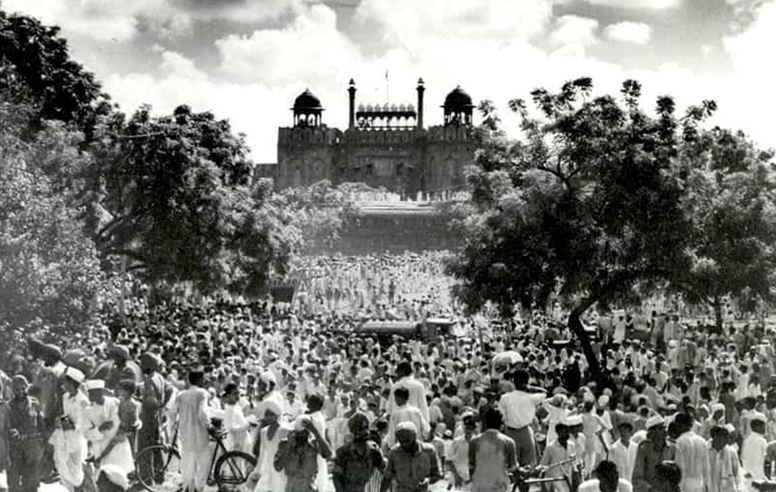
The creation and continuation of antagonism between Hindu-Muslim was the most significant accomplishment of British imperial policy: the colonial project of “divide et impera” (divide and rule) fomented religious antagonisms to facilitate continued imperial rule and reached its tragic conclusion in 1947.
However, I should say it never ended in 1947 as within months we started fighting on issue of Jammu and Kashmir, where the ratio of military personnel to civilians is the highest in the world. Many still die during gun battles, civilians caught in the crossfire.
The consequences of which affect this region till today since
it was pre-planned strategy of those sea dogs, to make this Golden Land to turn
into dust by continuous war and terror.

The British came under the disguise of traders; East India Company a
single business operation, based in one London office complex, managed to
dismantle the Mighty Mughal Empire as masters of the vast subcontinent. First,
they took our King, our riches, our precious Kohinoor and then our peace.
Till today we fight and maybe fighting continue for the end of our
lives, why? because they not only made lines dividing geography butlines on our
hearts. With time we are becoming more hostile, intolerant and unsympathetic.
Why we cannot sit and do table talk, why compassion cannot house in our hearts?
Because colonial mindsets persevere in more ways than we recognize, but
when we experience division – as Hindus and Muslims, or Indians and Pakistanis,
or any other ethnic group with those we perceive as our ‘natural’ enemies – we
should stop and ask ourselves who that division benefits.

However, the recent past witnessed some bounties of love, when Pakistani Prime Minister Imran Khan took the historic decision of opening the Khartarpur corridor and allowed visa-free entry to the Sikh pilgrim, besides another major step taken was the inauguration of Hassanabdal railway station for providing further facilitation to our Sikh fellows, where Imran showcased the world that Pakistan look forward for peace and good relations hence won hearts of several people.
He madethe historian to write his name in golden letters as the “Leader of Peace”.
I
believe if such steps could be replicated on the other side we could make this region
once again as strong, as rich and powerful as the times of Akbar the Great and
return the Golden Sparrow its glittering magnificence.
--------------
Munaza Kazmi holds MPhil in Management Sciences (Bahria University Islamabad, 2020). She’s a travel writer, an author, & co-author of scientific contributions in national & international publications. Her main areas of research include tourism & quality management.
-----------------------------------------------
Social Media
Search